Canadian Rockies Packing List for Multi-Generational Families: What We Actually Used
Everything we packed for the Canadian Rockies with twin four-year-olds, a six-year-old and grandparents in tow — tested, honest, no filler.
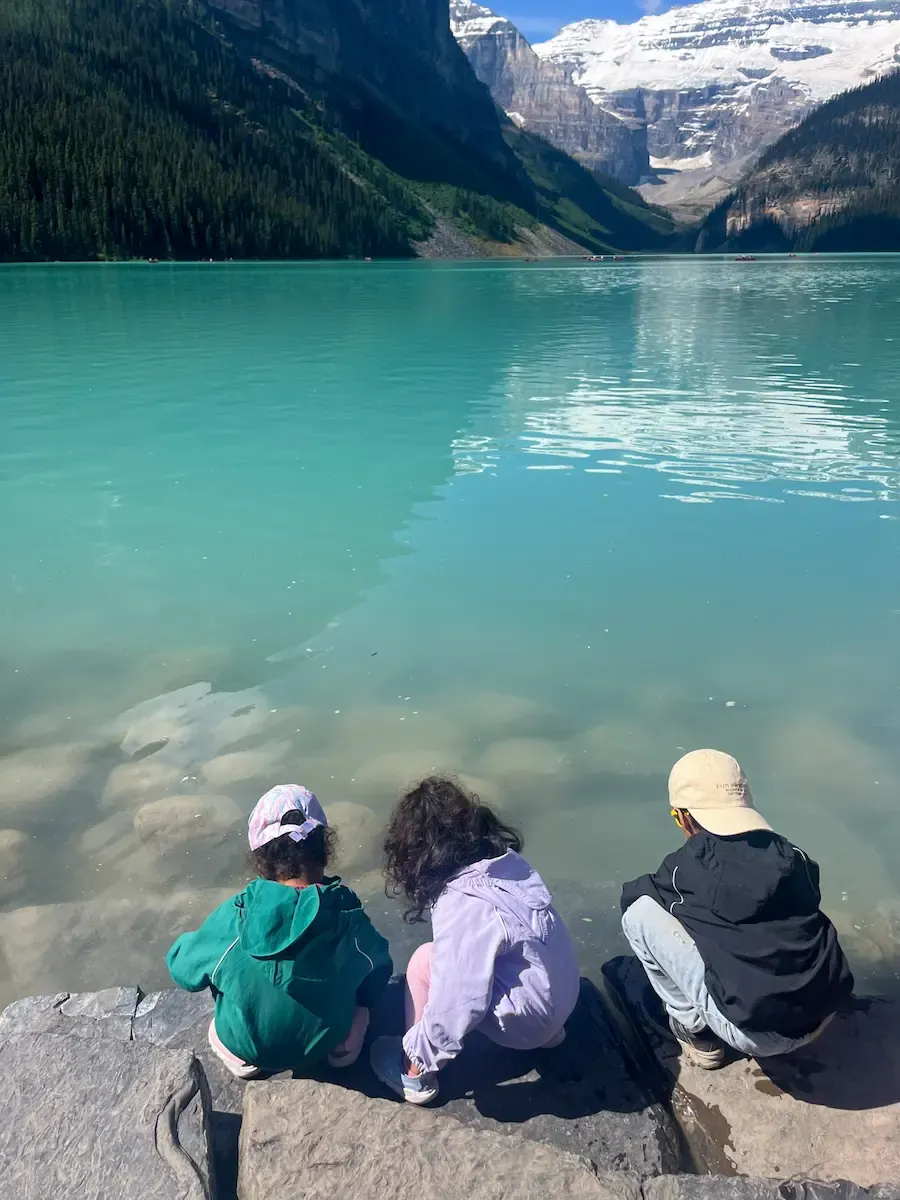
The hiking sticks appeared on day one at Johnston Canyon. My son found his within five minutes of leaving the car park — a solid pine branch, approximately the right height, carried with the gravity of someone who had been hiking his whole life. He is five. He named it. He carried it for six days. You cannot buy what that stick did for trail morale on the harder sections. But you can create the conditions — and that is what this packing list is for.
This post contains affiliate links
In This Guide:
- The Packing Philosophy
- For the Journey
- The Water Bottle Problem (And How We Solved It)
- Footwear: The Non-Negotiable Edit
- Layers: What Mountain Weather Actually Demands
- The Carrier That Saved Moraine Lake
- Stroller: When to Bring It, When to Leave It
- The Extras That Earned Their Place
- What We Left Behind
- The Master Packing List
- Top Tips
The Packing Philosophy for Multi-Generational Families
Packing for seven people across six days of mountain travel sounds like an exercise in chaos. And it is — until you have a system.
Ours came down to one rule: everything earns its place or it doesn't come. No "just in case." No extra pairs of anything that doesn't dry fast. No toys that require batteries.
The Rockies is not a place that forgives an overstuffed bag. You are in and out of a vehicle multiple times a day, carrying small children up steep trails, keeping grandparents comfortable across terrain that ranges from flat lakeshores to rocky canyon catwalks. Every item you pack is an item someone has to carry.
What follows is the honest edit — what we used daily, what earned cult status within 24 hours, and the one water bottle mistake we will never make again.
This is not a theoretical packing list. Every item listed was tested across six real days in Banff and Jasper with twin three-year-olds, a five-year-old, and grandparents aged 65 and 72.
For the Journey
The flight from the UK to Calgary is long. The drive from Calgary to Banff adds another hour and a half. And if you are doing the Icefields Parkway on day four, you are looking at three-plus hours of mountain driving. Plan for all of it.
The Snack System
Long flights and long drives require more than airport sandwiches. A multi-compartment snack box kept everyone fuelled with something decent at every transition point — no stopping at motorway service stations, no hangry toddlers in the back seat, no grandparents quietly declining because nothing on offer suited them. Fill it the night before every big travel day. Refill from your Safeway click and collect order at Calgary.
Backseat Cinema
For the Icefields Parkway stretches where even the most mountain-obsessed five-year-old has run out of enthusiasm, an iPad cover with headrest straps turns the back seat into a private cinema. Lifesaver. Use it without guilt.
Battery Pack
Between navigation, photography, and the inevitable moment someone's phone dies at the top of a gondola, a slimline battery pack in the day bag is non-negotiable. Ours lived in the Patagonia backpack for six days and was used every single one of them.
Travel First Aid Kit
One thing that earned its place quietly: a small travel first aid kit in the car boot. With three children under six and grandparents on uneven terrain, it was never dramatically needed — but the peace of mind of having it there across six days of mountain hiking, canyon catwalks and glacier walks was worth every penny. Plasters, antiseptic wipes, a bandage, and children's paracetamol. The basics. The ones you only think about when you need them and don't have them.
Kids Wireless Headphones
The iPad cover handles the screen. The headphones handle the peace. A pair of wireless headphones per child means the back seat becomes genuinely self-contained — no tinny audio bleeding into the front, no squabbling over who gets the wired pair, no cable pulled out at a critical plot moment. Ours lived in the day bag and came out on the Icefields Parkway stretches where even the most enthusiastic five-year-old had exhausted his interest in glaciers. These ones fold flat, are durable enough to survive a toddler, and have a volume limit built in so you're not worrying about small ears on a long drive.
The Water Bottle Problem (And How We Solved It)
Let's start here because it nearly broke us on day one.
Seven people. Seven water bottles. Seven different sizes, lids, and carrying systems. By the time we reached Johnston Canyon, we had a backpack that was essentially a water bottle museum. Getting anything in or out required unpacking half of it first.
Here is what we learned by day two: one large communal bottle in the car, individual soft pouches for everyone on the trail.
The car bottle is a Hydro Flask 60oz Wide Mouth. It keeps water cold for 24 hours and sits in the boot acting as the refill station every time you return from a trail. We'd fill it the night before at Hotel Canoe and it was still cold when we got back from Johnston Canyon four hours later. Cold water waiting for you at the car after a long morning on the mountain is not a small thing. It is the reset that makes the afternoon possible.
On the trail, everyone carries a soft water pouch (we picked these up in Banff Town), save yourself the stress and get them before you go. They compress to nothing when empty, weigh almost nothing full, and fit in every pocket, every backpack side slot, and every small hand. The twins managed their own. The grandparents kept theirs in their jacket pockets.
"Seven water bottles in one bag is the fastest way to ruin a perfectly good hike. One Hydro Flask in the car and soft pouches on the trail is the only system that works."
Footwear: The Non-Negotiable Edit
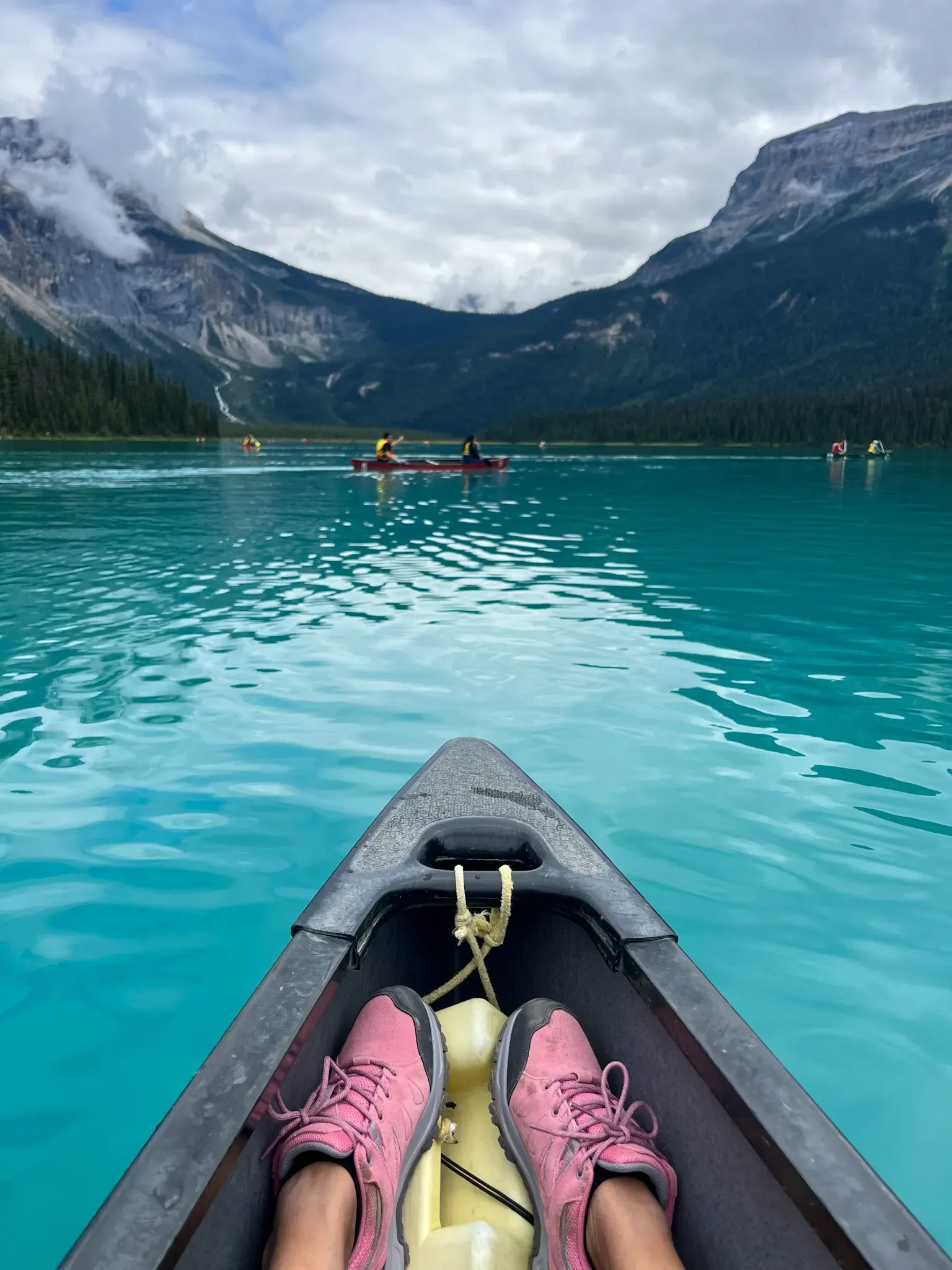
I said thank you for the hiking boots more times on this trip than for almost anything else.
The moment I understood why: halfway up the rocky approach to Moraine Lake viewpoint, carrying a twin on my back, the terrain shifted from packed trail to loose, uneven rock. My hiking boots gripped. My husband's trainers did not have the same confidence. The difference between a boot with ankle support and a trainer on that surface is not a comfort difference. It is a safety difference.
For the grandparents, walking poles and boots with proper ankle support transformed what would have been genuinely difficult terrain into something manageable and even joyful. My dad — 72, not given to hyperbole — said the boots and poles together were the best kit decision of the trip.
For the children, Crocs are the single best secondary shoe you will pack. The moment a trail ends, the boots come off and the Crocs go on — and that transition takes approximately four seconds. After six hours in hiking boots, those four seconds matter more than you'd think.
Layers: What Mountain Weather Actually Demands
Mountain weather in the Canadian Rockies operates on its own logic. It can be 22°C in Banff town and 14°C at the Moraine Lake viewpoint in the same afternoon. Wind appears from nowhere. Rain arrives and departs within the hour. You dress for all of it simultaneously.
The rain shells were the most-reached-for item of the entire trip. Lightweight enough to stuff into a day bag and forget about, waterproof enough for actual alpine showers, and bright enough to spot a child who has wandered six feet ahead of you on a crowded viewpoint. We wore them on at least four of the six days.
For the grandparents, the thermos mattered as much as the layers. Every morning at Hotel Canoe we filled it from the hotel's coffee and tea supplies before setting off. My parents sat in the front seat of our Chrysler Pacifica watching mountain views unspool through the windscreen, warm drinks in hand, completely at ease. That image — grandparents settled and content, the Rockies going past — is one of the ones I keep returning to.
"The grandparents had their thermos of tea from Hotel Canoe, their layers adjusted exactly right, and they stood at Waterfowl Lake looking at mountain reflections like they had been doing this their whole lives. That is what slow travel actually looks like."
The Carrier That Saved Moraine Lake
This deserves its own section. Not because it's an exciting piece of kit. Because without it, we would not have reached the Moraine Lake viewpoint.
The approach to the viewpoint is steep, rocky, and — without a private guide — crowded. No stroller. No buggy. No alternative for a three-year-old who has run out of walking will.
Thankfully we had booked a private tour which meant we moved entirely at our own pace — no group to keep up with, no fixed schedule, no waiting at the viewpoint with strangers. Our guide adjusted to whoever needed a moment: grandparent on the steeper section, toddler deciding she wanted to walk after all, five-year-old suddenly in his element and completely unstoppable on the rocks. For a multi-generational family on that terrain, a private tour is not an upgrade. It is the right way to do it.
And the carrier made it possible.
The moment I will not forget: ten minutes into the ascent, one twin on my back in the toddler backpack carrier, the gradient increasing, the rocks getting looser underfoot. My husband had the other twin on his shoulder. My parents had my son's hands. And at the top — the most extraordinary view I have ever seen. My son walked every step without a single complaint, free in nature, completely absorbed in the anticipation of something remarkable. He gasped when he saw it. We all did. The carrier that made Moraine Lake possible — full story in our Moraine Lake guide.
Every step was worth it. But you do not reach that view without the right equipment.
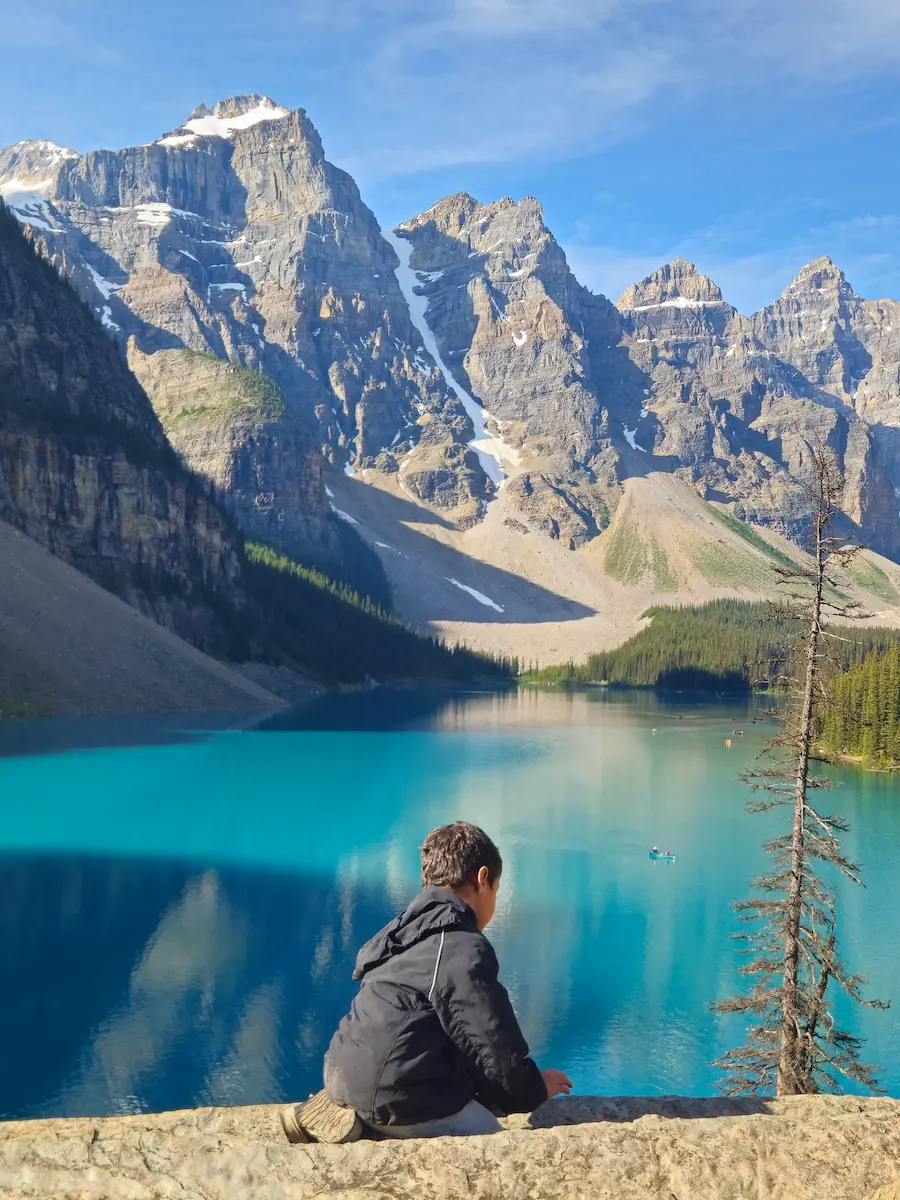
The toddler backpack carrier we used distributed weight across hips rather than shoulders. For a rocky uphill with a 14kg child, this is not optional. Hip carry versus shoulder carry is the difference between arriving at the viewpoint feeling like a warrior and arriving unable to lift your arms.
Stroller: When to Bring It, When to Leave It
The honest answer: it depends entirely on the day.
Leave it at the hotel for: Johnston Canyon (catwalks), Moraine Lake viewpoint (rocky ascent), Banff Gondola summit (boardwalk), any canyon trail.
Bring it for: Banff town walks, Lake Minnewanka shore, Johnston Lake flat walk, Banff Avenue browsing, any flat lakeside path.
The lightweight travel stroller we brought folded into the boot of our Chrysler Pacifica in approximately twelve seconds. This matters when you are repacking the car six times a day. The Chrysler Pacifica was the perfect vehicle for seven people — sliding doors, three-row seating, a boot large enough for a stroller, a carrier, seven bags, and the contents of a Safeway shop. Do not underestimate the vehicle choice. This is your moving base camp for six days.
Peyto Lake is the rare exception — the walk to the viewpoint is largely paved and stroller-accessible. One of the few major viewpoints where you don't need to leave it behind.
The Extras That Earned Their Place
Universal Travel Adapter
One adaptor. Every country. No googling which plug fits where, no panic at the hotel desk, no borrowing from a stranger in the corridor. A universal travel adapter covers every destination and has enough USB ports built in to charge multiple devices simultaneously. Ours has been on every trip we've taken and it is the one item that has never once let us down. Pack one. You will never think about plugs again.
The Hiking Sticks
Natural ones. Found on day one at Johnston Canyon. Carried for six days. My son treated his with a seriousness that suggested he believed it had powers. The twins named theirs.
You cannot buy what those sticks did for trail morale on the harder sections. But you can create the conditions by letting small children find their own on the first day and — this is the important part — protecting those sticks with your life for the remainder of the trip.
Uno
We bought Uno Junior on a whim before the trip. It came everywhere. We played it at the top of the Banff Gondola with six mountain ranges visible through the café windows — a five-year-old who had been walking for three hours, grandparents who had just ridden a cable car to 7,486 feet, twins who somehow grasped the rules immediately. Twenty minutes of Uno reset the whole group.
We play it at home now and every time someone says the same thing: remember when we played this at the top of the gondola.
Pack it. It weighs nothing. It creates the kind of shared family memory that outlasts the trip.
LED Writing Pads
Already covered in the journey section but worth repeating here: LED writing pads for the restaurant every evening. Mess-free, screen-free, endlessly reusable. The twins drew mountains every night.
What We Left Behind
Individual water bottles for everyone. Seven bottles in one backpack is a game of Tetris you lose every time. The Hydro Flask in the car, soft pouches on the trail — day two felt like a completely different trip. Do not attempt the seven-bottle system even once.
The changing bag we used at home. Too bulky, too structured, too many compartments we never once opened. A simple zip pouch — nappies, wipes, cream, one spare set of clothes — fits inside the main day bag and weighs almost nothing. On mountain terrain, every gram counts.
Multiple toy options. We brought three. We used one — Uno. The rest stayed in the case for six days. One brilliant game and whatever the children found on the trail was everything they needed.
Anything that doesn't dry fast. Cotton everything stayed home. Quick-dry everything came. After Johnston Canyon in the rain, we were grateful for every single synthetic fibre.
The Master Packing List
For the Journey
- Multi-compartment snack box
- iPad cover with headrest straps
- Slimline battery pack
- Kids Wireless Headphones
- LED writing pads — one per child
Hydration
- Hydro Flask 60oz Wide Mouth— one for the car
- Soft water pouches — one per person for the trail
Footwear
- Hiking boots with ankle support — adults and grandparents
- Walking poles — grandparents, essential not optional
- Crocs — one pair per child, clip to bag
Clothing
- Ultra-lightweight rain shells — one per person, buy a size up for children
- Base layer per person
- Mid-layer fleece — especially important for grandparents
- Quick-dry trousers — adults and older children
Carrying
- Toddler backpack carrier — non-negotiable for rocky trails
- Lightweight travel stroller — one between two toddlers
Entertainment
- Uno — pack it, thank yourself later
- LED writing pads — already listed above, worth listing twice
Vehicle
- Chrysler Pacifica or premium 7-seater SUV— book at Calgary Airport, book early
Top Tips
- Solve the water bottles first. One large Hydro Flask in the car, soft pouches on the trail. Do not attempt seven individual bottles.
- Buy the hiking boots before you go. Not at the trailhead. Not from the hotel gift shop. Proper boots, worn in before the trip, every time.
- Let the children find sticks on day one. Then protect those sticks. They are worth more to trail morale than anything you could buy.
- The rain jackets go in the day bag every single day. Even if the sky is blue. Especially if the sky is blue.
- One lightweight stroller is enough. The carrier covers what the stroller can't. Two strollers is unnecessary weight.
- Pack Uno. One box, zero regrets, permanent family memory.
- Fill the thermos every morning at Hotel Canoe. Tea in the car while the mountains go past is slow travel at its most effortless.
- Use the Safeway click and collect hack. Place your order before you fly, collect at Calgary on arrival day. Full details in our 7-day Canadian Rockies itinerary.
- Give grandparents their own small day bag. Their layers, their thermos, their poles. Autonomy over their own kit makes the pace feel easier for everyone.
- Book a private tour for Moraine Lake. The public shuttle has fixed times and no flexibility. A private guided tour moves at your family's pace. For multi-generational groups, there is no comparison.
Planning Your Trip
This packing list works hardest when your trip is properly planned. Read our full 7-day Canadian Rockies itinerary with toddlers and grandparents for the day-by-day plan that everything above was packed for.
For where to stay, our Hotel Canoe & Suites honest review covers the base that made every morning start possible — including where the thermos gets filled.
And if you are planning Moraine Lake, a private guided tour is the single best thing you can book for a multi-generational family.
The Icefields Parkway with Toddlers and Grandparents — the drive day this packing list is really written for. Every stop, every snack break, and the in-car kit we relied on.
Jasper with Toddlers and Grandparents — the Jasper leg of the trip, including the Maligne Lake cruise and the falls worth stopping for.
Heading somewhere new with toddlers and grandparents? Our Switzerland with toddlers and grandparents itinerary
Cloud Kissed Adventures — aspirational but accessible luxury travel for families who refuse to stay home. All recommendations are personal experience: nothing sponsored, everything tested with a three-year-old on my hip and a 72-year-old on hiking poles. This post contains affiliate links for products and services I genuinely used and loved. If you book through them, I may earn a small commission at no extra cost to you. Thank you for your support — it keeps these guides free and detailed for families like yours.