The Switzerland Itinerary for Travelling with Grandparents and Toddlers: 7 Days Based in Wengen
A real 7-day Switzerland itinerary with grandparents, twin toddlers, and a six-year-old — based in Wengen. Honest pace, what worked, what to skip.
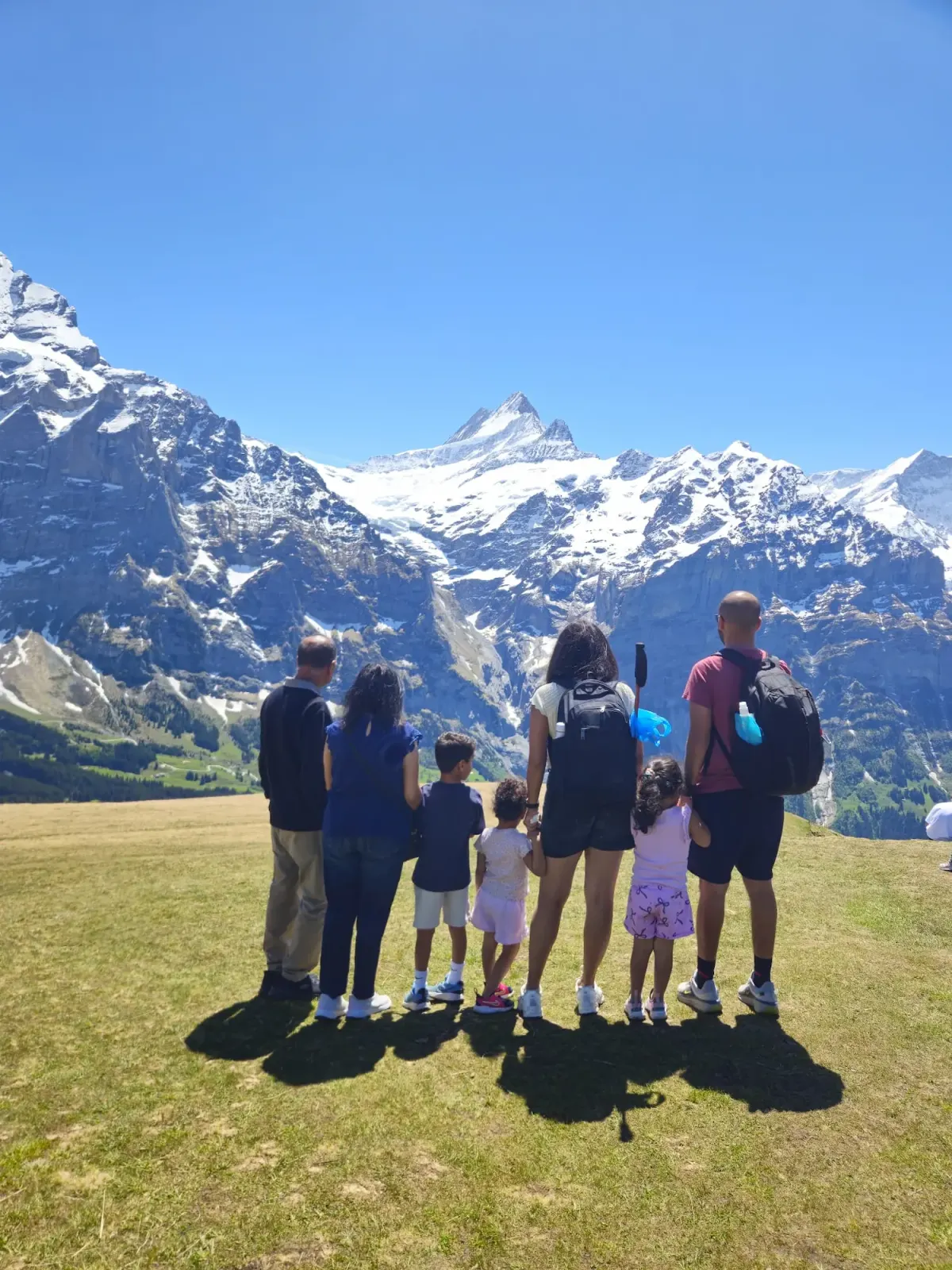
Is the Jungfrau region worth the effort with twin toddlers, a six-year-old, and two grandparents in their late sixties and seventies?
Yes. We did it. We'd do it again tomorrow. But the honest answer is the longer one, and that's what the rest of this post is for.
We based ourselves in Wengen for six nights. We skipped Jungfraujoch. We were caught out by unexpected heat in May. We stumbled into the best day of the trip by accident. And our grandparents did things on that trip we didn't think they'd be able to do — but only because we'd built the week around the reality of travelling with them, not against it.
This post contains affiliate links
In This Guide:
- Why We Chose Wengen as Our Base (Not Grindelwald)
- Where We Stayed in Wengen: Hotel Brunner Apartment
- How to Get Around the Jungfrau Region (And the Pass System That Makes It Work)
- Day 1: Arrival, the Apartment, and the Honest Reality of Long-Haul Travel with Grandparents and Toddlers
- Day 2: Grindelwald First Cliff Walk and the Pfingstegg Toboggan
- Day 3: Mürren, Gimmelwald, and the 75-Minute Downhill Walk That Grandparents Did the Whole Way
- Day 4: The Royal Ride and the Royal Walk (And Why We Took the Train Back, Not the Walk Down)
- Day 5: Lake Brienz with Toddlers and Grandparents (The Day We Skipped Jungfraujoch For)
- Day 6: Schilthorn (Piz Gloria), the Birg Thrill Walk, and Allmendhubel
- Day 7: Departure Day Done Right (Lindt Home of Chocolate on the Way to Zurich Airport)
- The Two Running Themes (Read This Before Booking)
- Swiss Family Infrastructure: Things Nobody Wrote About But We Couldn't Believe
- Top Tips for Switzerland with Grandparents and Toddlers
- What to Pack for the Jungfrau Region with Toddlers and Elderly Parents
- Practical Information
- Planning Your Trip: What Reads Next
Why We Chose Wengen as Our Base for Travelling with Elderly Parents and Toddlers
Wengen was the right call for our family. Not because Grindelwald is wrong — but because the two villages are answering different questions, and only one of them was answering ours.
We needed quiet. We needed somewhere our grandparents would feel restored at the end of a day rather than stimulated. We needed a base small enough that a tired six-year-old could walk back to his bed in ten minutes after dinner.
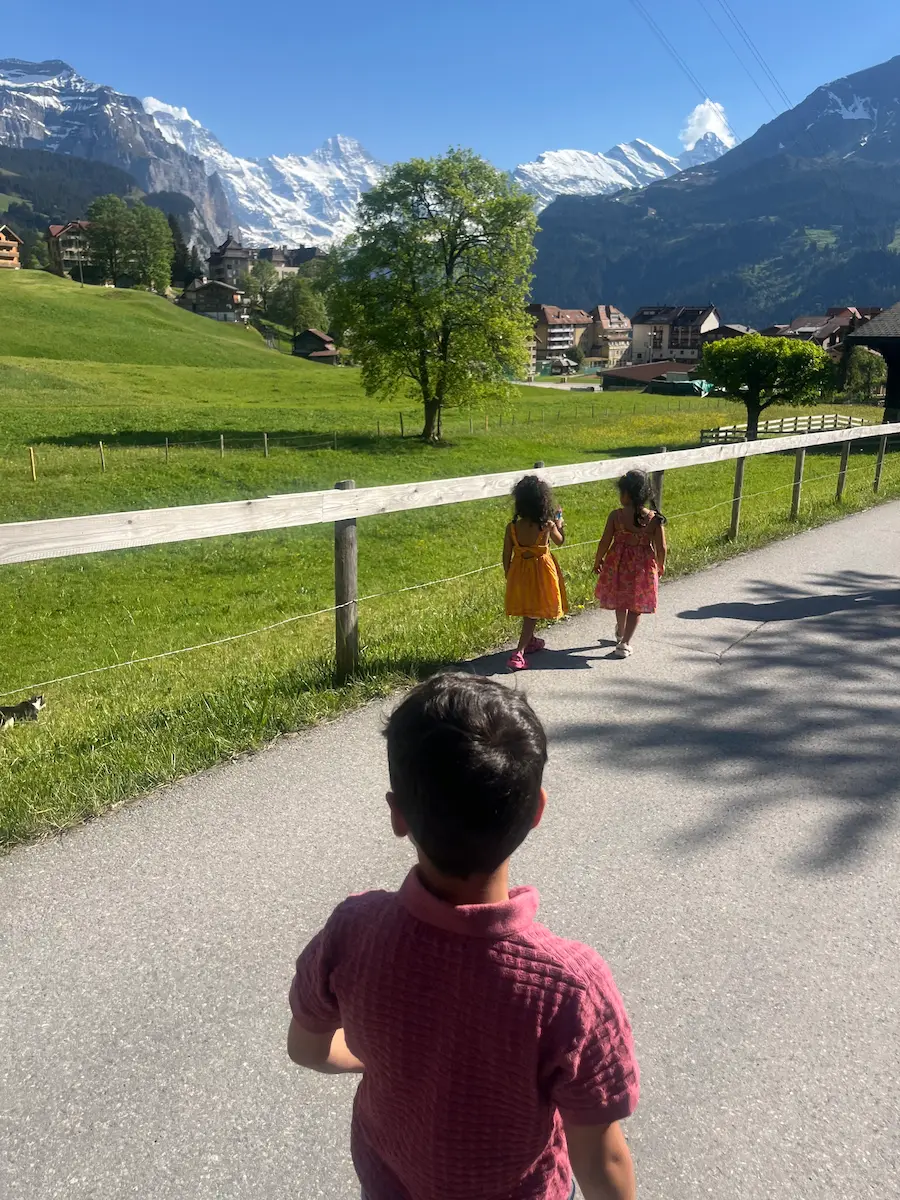
Wengen is car-free in the specific way that means the village sounds are footsteps and trains. Not engines. Not horns. You can hear the cowbells from the meadows below. The whole village feels like it was designed for the postcard and then someone forgot to leave. It's also not full of tourists. You feel like you blend in with the locals being part of their little secret that the rest of the world hasn't caught on to quiet yet. This level of peace, fresh mountain air with snow capped mountains in every backdrop. Paradise.
Grindelwald is bigger, busier, has more restaurants and more direct cable car access to the headline mountains. If you're travelling without grandparents and your priority is moving fast, Grindelwald is probably the right answer.
For us, Wengen won. We left it most days. But we came back to silence and a wraparound balcony at four in the afternoon. That balcony was the trip. Read our full review on Wengen and our apartment here.
The honest trade-off: our apartment was a ten-minute uphill walk from the train station. Doable, but not multiple times a day in heat. Those were the hardest ten minutes of every day. They were also completely worth it for the peace that waited at the top. There are some electric taxis, we got one on arrival day to save ourselves lugging our bags up the hill, best 30 francs we spent in the entire trip.
Where We Stayed in Wengen: The Apartment That Worked for Our Multi-Generational Family
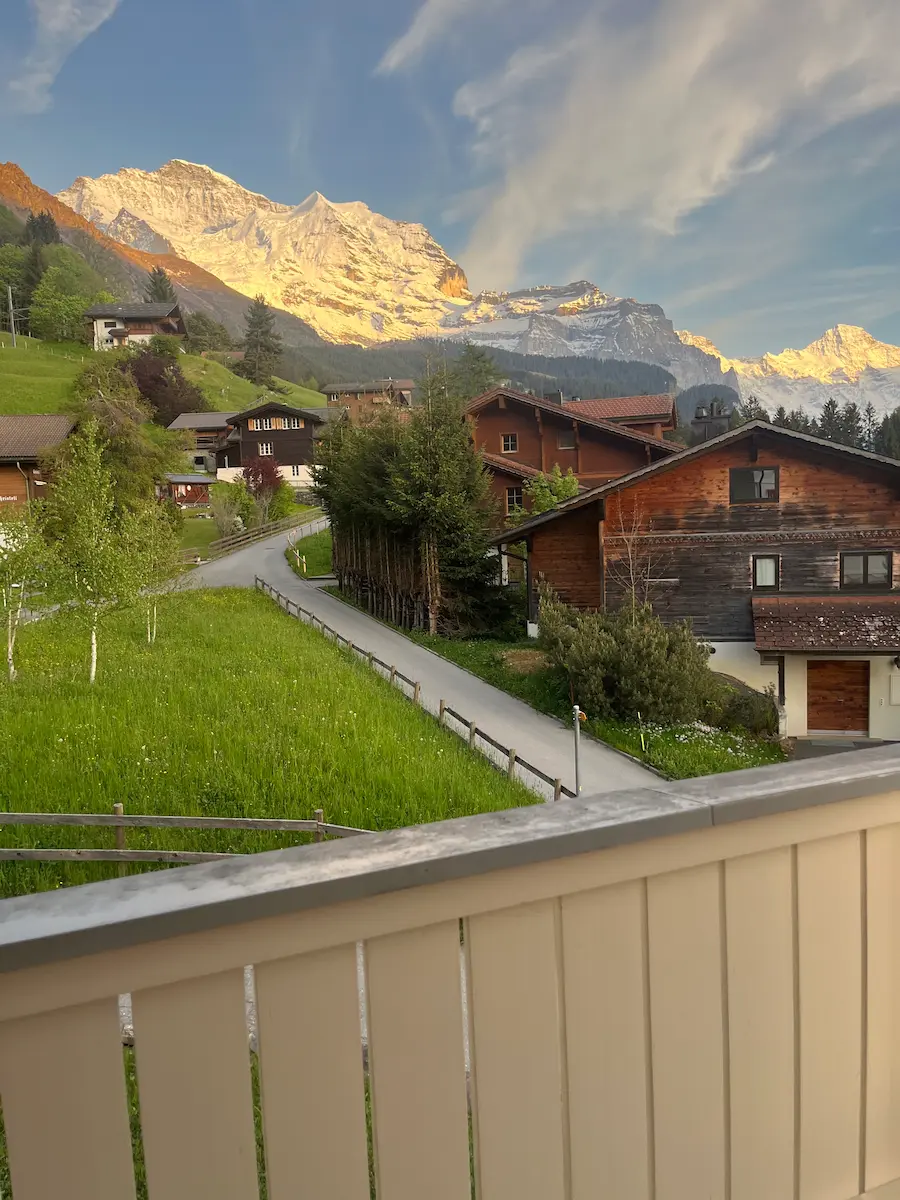
The apartment is the reason the whole trip worked. Check Availability for the Wengen Apartment here.
Three bedrooms — one king, two doubles. Two bathrooms. A full kitchen with a washing machine. And the wraparound balcony, which is where every evening of the trip ended.
A hotel for four adults plus three kids would have meant two or three rooms, no shared space, no kitchen, and a dinner negotiation every night. The apartment meant the twins shared a room and went to bed at seven while the adults sat on the balcony with wine and watched the light move across the Eiger. The grandparents had their own room with a door that closed. We had ours. Nobody was negotiating space.
The kitchen mattered more than I expected. Breakfast in the apartment, lunch packed for whatever mountain we were heading up, snack box prep from Coop shopping. That's how the day worked, knowing we were fuelled and could stop and have our lunch wherever we wanted rather than trying to find somewhere and fit it in. The washing machine meant we packed lighter than we would have for a hotel.
How to Get Around the Jungfrau Region with Seniors and Toddlers (And the Pass System That Makes It Work)
Getting around the Jungfrau Region is its own planning challenge — passes, cable car connections, and the one rule that saved the second half of our trip. Full guide here: Getting Around the Jungfrau Region with Grandparents and Toddlers.
Here's the headline. You buy your travel once, at the start of the trip, and for the rest of the week you stop thinking about tickets. No queuing at cable car kiosks. No working out which trains your card covers. No pulling out a credit card on a mountain platform with three tired children. You scan, you board, you go.
That sounds small. After three days of doing it, you understand it is enormous.
The Berner Oberland Pass (BOP)
The regional pass for the Jungfrau region. It covers most trains, buses, cable cars, funiculars, and the steam boats on Lake Brienz and Lake Thun. Available for 3, 4, 6, 8 or 10 consecutive days. We bought the six-day pass to cover our trip (excluding departure day).
It includes free travel on most things. Discounts of 25-50% on the few attractions it doesn't fully cover — Grindlewald First and Jungfraujoch among them. For an itinerary like ours, the maths is straightforward: the pass paid for itself by Day 3.
Stack It With the Swiss Half Fare Card
The Swiss Half Fare Card is a separate national rail card. It gives you 50% off most train, bus and boat travel across Switzerland for a month. And — this is the bit that matters — it also discounts the Berner Oberland Pass itself.
Buy the Half Fare Card first. Then buy the BOP on top. Your BOP cost drops by the same proportion.
If you're flying into Zurich, the Half Fare Card also halves your initial transfer to the Jungfrau region. Two trips covered by one card before you've even arrived.
The Swiss Family Card (Kids Travel Free)
This is the bit no other family travel blog explains properly.
The Swiss Family Card is issued for free with most rail products — including the Swiss Travel Pass and the Half Fare Card. It lets children aged 6 to 15 travel free on most Swiss public transport when accompanied by a parent or grandparent holding a valid ticket.
Children under 6 travel free anyway, with or without the card.
For us, this meant our four-year-old twins travelled free everywhere because they were under six. Our six-year-old travelled free everywhere because of the Family Card. Three children. Zero transport cost for the entire week.
Get the Swiss Family Card when you buy your Half Fare or BOP (you will see an option to add it for free).
What This Looks Like at the Cable Car Station
You walk up. You scan. You board.
That is the whole interaction. No queue. No working out child pricing. No upgrading to include the next attraction. The pass lives in the SBB Mobile app, the cable car staff scan it from your phone, and you're on.
We watched other families queue at every cable car station for 15-20 minutes per attraction. With three children and two grandparents, that compounds. The pass eliminates it.
The Honest Bit: Swiss Trains Are Precise, Not Forgiving
The pass solves the ticket problem. It does not solve the navigation problem.
Swiss train connections are tight. You have minutes to change platforms. It seems impossible. It is not. But you need to know which platform your next train leaves from before you get off the current one.
This is fine for a logistics-confident adult travelling alone. With grandparents, with toddlers who need the toilet, with luggage that doesn't lift itself, it is genuinely demanding.
Our grandparents could not have done this journey independently without getting lost and flustered. That's not a criticism of them or the trains. It's a statement of fact about what this region requires. If you're sending older parents to "meet you there" rather than travelling together, Switzerland is not the right country for that plan.
Use the SBB Mobile app. Check your next platform before you get off your current train. Travel as one group through every transition.
Day 1: Arrival, the Apartment, and the Honest Reality of Long-Haul Travel with Grandparents and Toddlers
We flew short-haul from London to Zurich on Avios — free flights, which softens the cost of everything that comes after. We packed for the train day properly: a multi-compartment snack box, iPad covers with headrest straps, wireless headphones for the kids, a slimline battery pack, a magnetic travel game pack, and travel pillows for the grandparents.
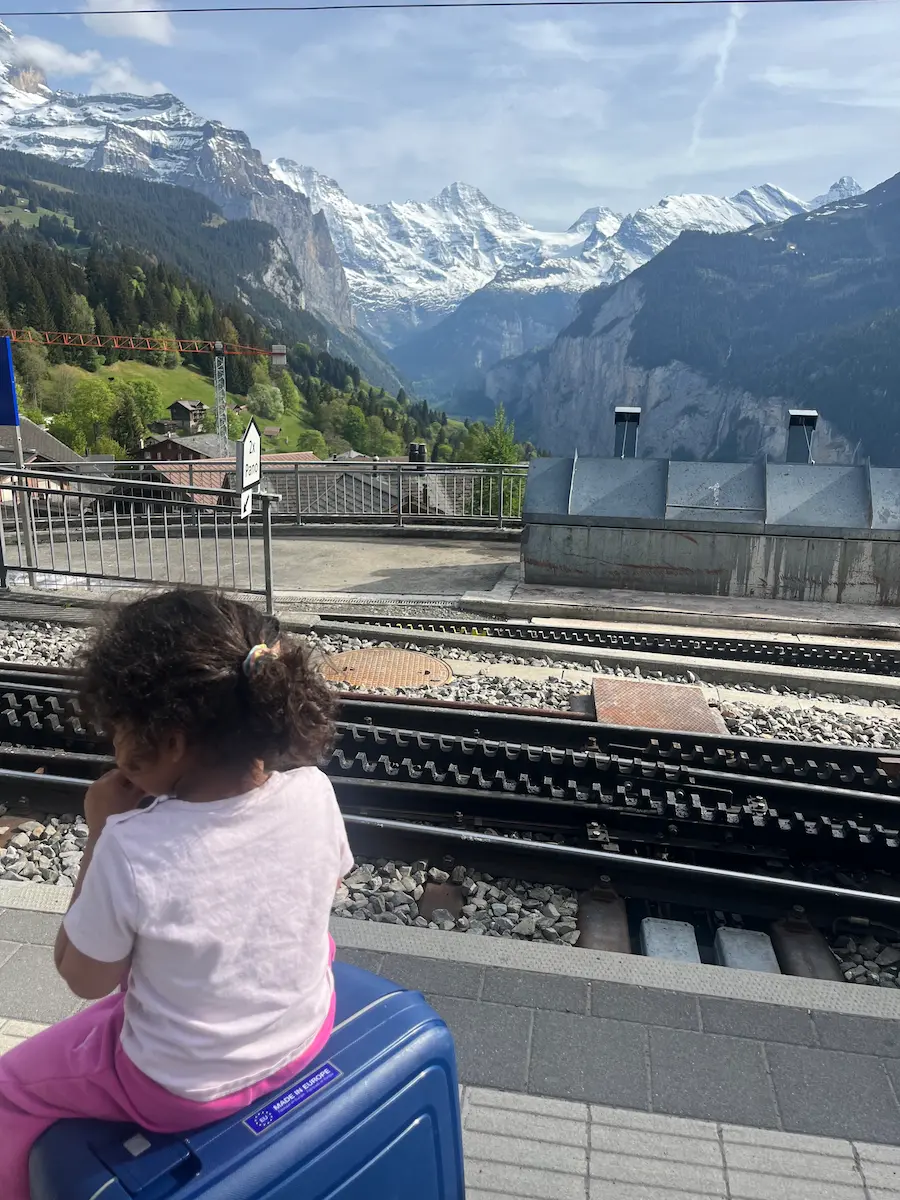
The route from Zurich Airport to Wengen is three to four trains depending on what route you choose and timing. We opted to go via Lucerne to catch the Lucerne–Interlaken Panoramic Express as it was covered by our BOP.
It sounds heavy. It nearly is. But the last two legs are short and scenic enough that they restore rather than deplete you. And the panoramic train in the middle was the highlight of the whole journey for the grandparents — neither of them had ever done a scenic train route before, and the first sighting of Lake Brienz from the carriage window earned every word ever written about it. By the time we arrived in Wengen early evening, we'd already decided that nothing else was happening that day.
Pizza on the balcony. Bath. Bed.
Most itineraries try to make arrival day count. Get to your base, drop bags, head out to see something. With a multi-generational family arriving from a long-haul or short-haul-plus-three-trains journey, that ambition is a tax you pay for the rest of the week. Tired kids don't sleep well. Tired grandparents don't recover overnight. Tired parents make worse decisions for the next six days.
The apartment, the takeaway pizza, the balcony, the early bath — that was the most useful thing we did all week. Day 1 set up Day 2.
Day 2: Grindelwald First Cliff Walk and the Pfingstegg Toboggan (What Worked for Toddlers and Older Travellers)
This was the day that set the tone for the trip — for what worked, and for what we learned about pace.
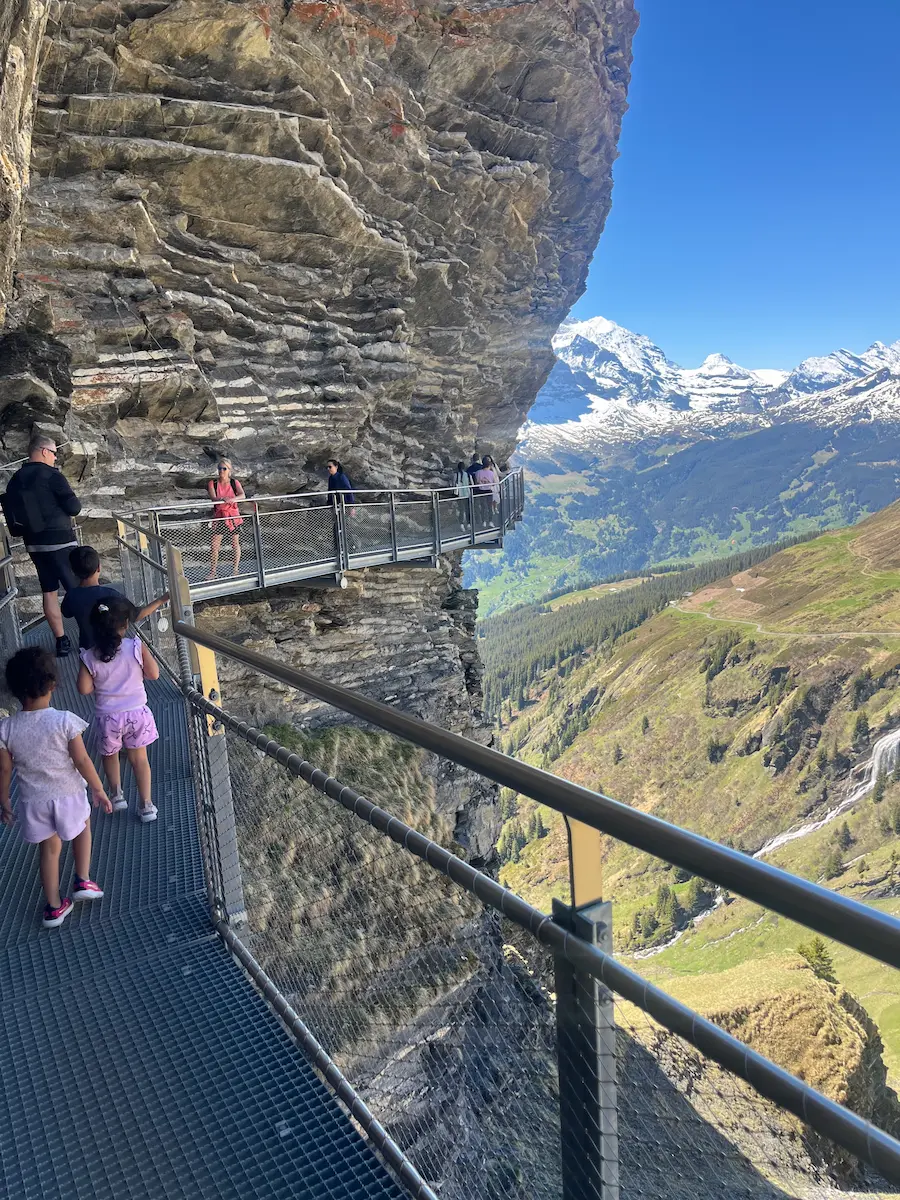
We planned three things. Grindelwald First with the cable car (50% off with BOP) up to the Cliff Walk. Bort playground on the way down. Then Pfingstegg for the summer toboggan run. We had to drop Bort because the playground was closed for maintenance. In retrospect, it was a blessing.
The Cliff Walk was a universal hit. The metal walkway bolted to the cliffside looks more vertiginous in photos than it feels in person — broad, secure, with chest-high panels at the exposed edges. Our grandparents did the whole walk and stopped at every viewpoint to take photos. The twins ran across with zero hesitation. Our six-year-old was the cautious one — he held a hand and walked slowly. None of those reactions is the wrong one. The Cliff Walk accommodates all of them.
After lunch in Grindelwald village we went up to Pfingstegg.
This was the surprise. A small plateau at the top of a short cable car ride (covered by BOP). A playground. A bouncy castle. A zip wire. A cafe with a terrace. And the 736-metre summer toboggan run that turned out to be the biggest single hit of the entire trip.
All three kids did the toboggan with an adult. The minimum age to ride alone is eight; younger children ride with a grown-up tucked in front of them. The grandparents sat with coffee and watched. Our four-year-old twins came off the first run breathless and asking when they could do it again. We did it twice more.
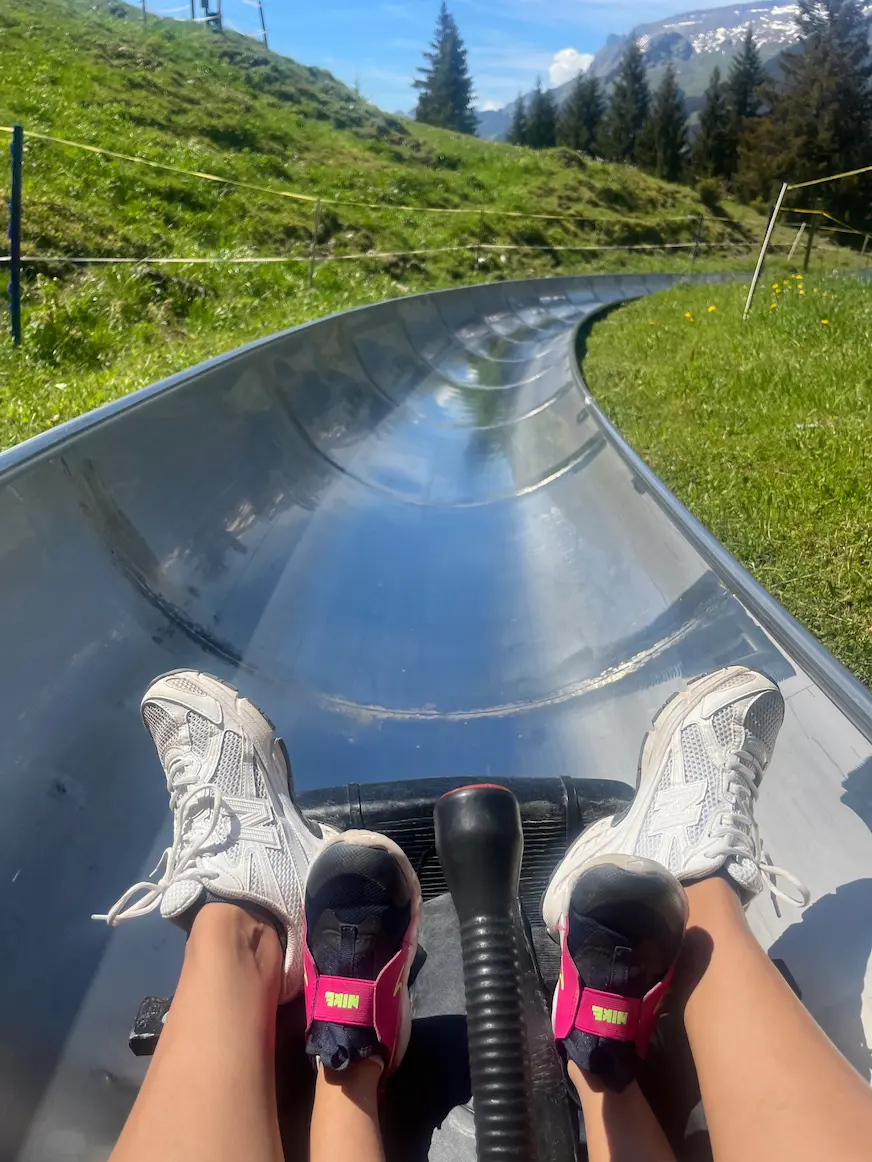
They asked to come back every day for the rest of the week. We never did. That's how good it was.
Day 3: Mürren, Gimmelwald, and the 75-Minute Downhill Walk That Grandparents Did the Whole Way
If I had to keep only one day from the whole trip, I'd keep this one.
The Lauterbrunnen–Grütschalp cable car was closed for maintenance — the second closure of our week, which tells you something about checking before you go. The workaround is the 141 bus to Stechelberg then the Schilthornbahn cable car up (covered by BOP). Packed and unglamorous, but it gets you there. Worth checking before each travel day whether anything along your planned route is closed; we hit two closures in seven days.
Mürren itself was a relief. We walked the village. The kids found a big trampoline in the park. The grandparents mooched through the small shops while we sat with the kids on the trampoline.
This split-the-group dynamic happened most days. It's the unspoken rhythm of multi-gen travel — you converge for meals and views, you diverge for everything else. Both halves get what they need.
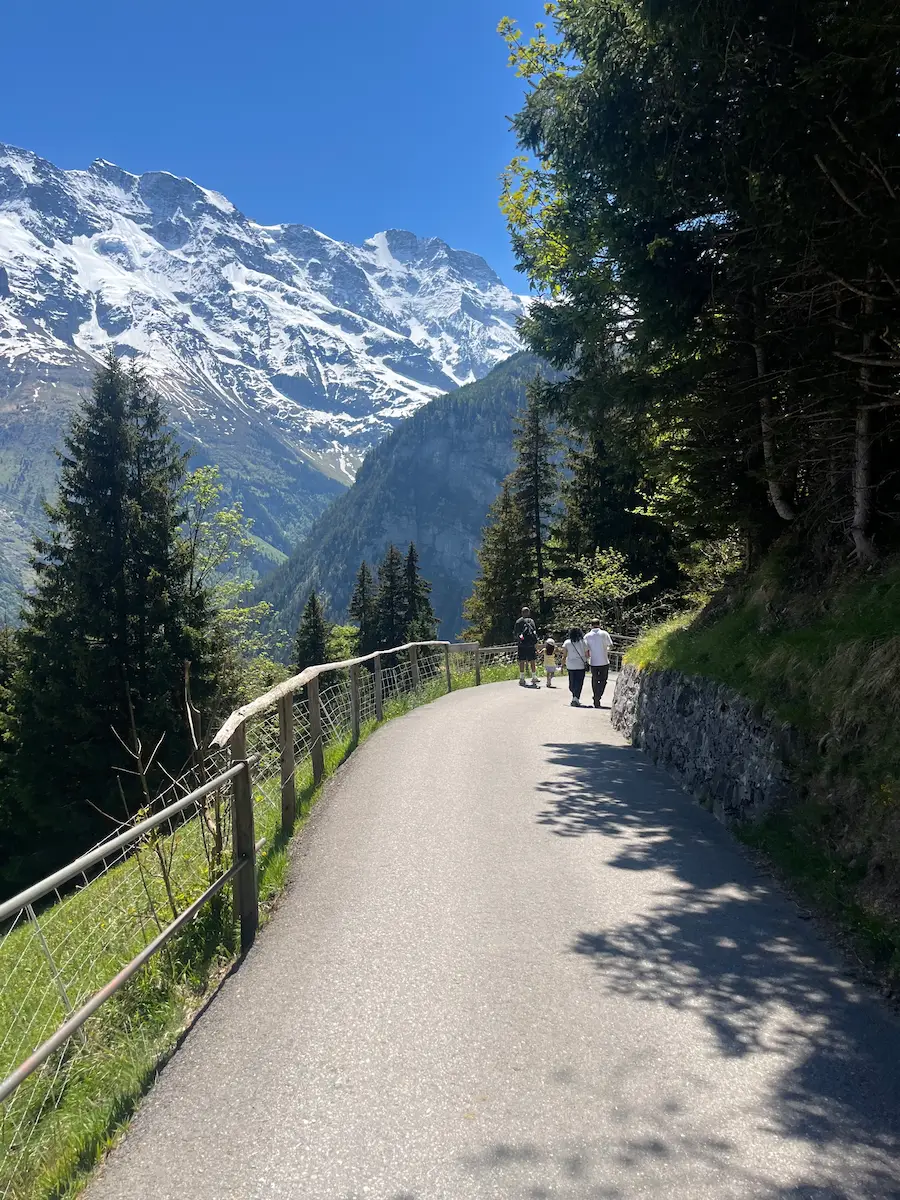
The walk from Mürren down to Gimmelwald is the kind of trail you tell people about. All downhill. Broad enough for a stroller, though we didn't take ours. Passing meadows and cows and the kind of views that make you stop mid-sentence.
It took us 75 minutes at slow pace. Our grandparents did the entire walk, no issues. Five minutes in, the heat got to one of the twins and the meltdown started — the kind that doesn't stop for landscape, no matter how good the landscape is.
My husband started a game. Pick a category, take turns to name things in that category until someone repeats a word and then chose a new category. Animals first. Then colours. Then Disney princesses, by request. The twin who was crying joined in around the third round. By the time we reached Gimmelwald, my mother was the reigning Disney princess champion and nobody was thinking about the heat any more.
Lunch at the Mountain Hostel in Gimmelwald was the best meal of the trip.
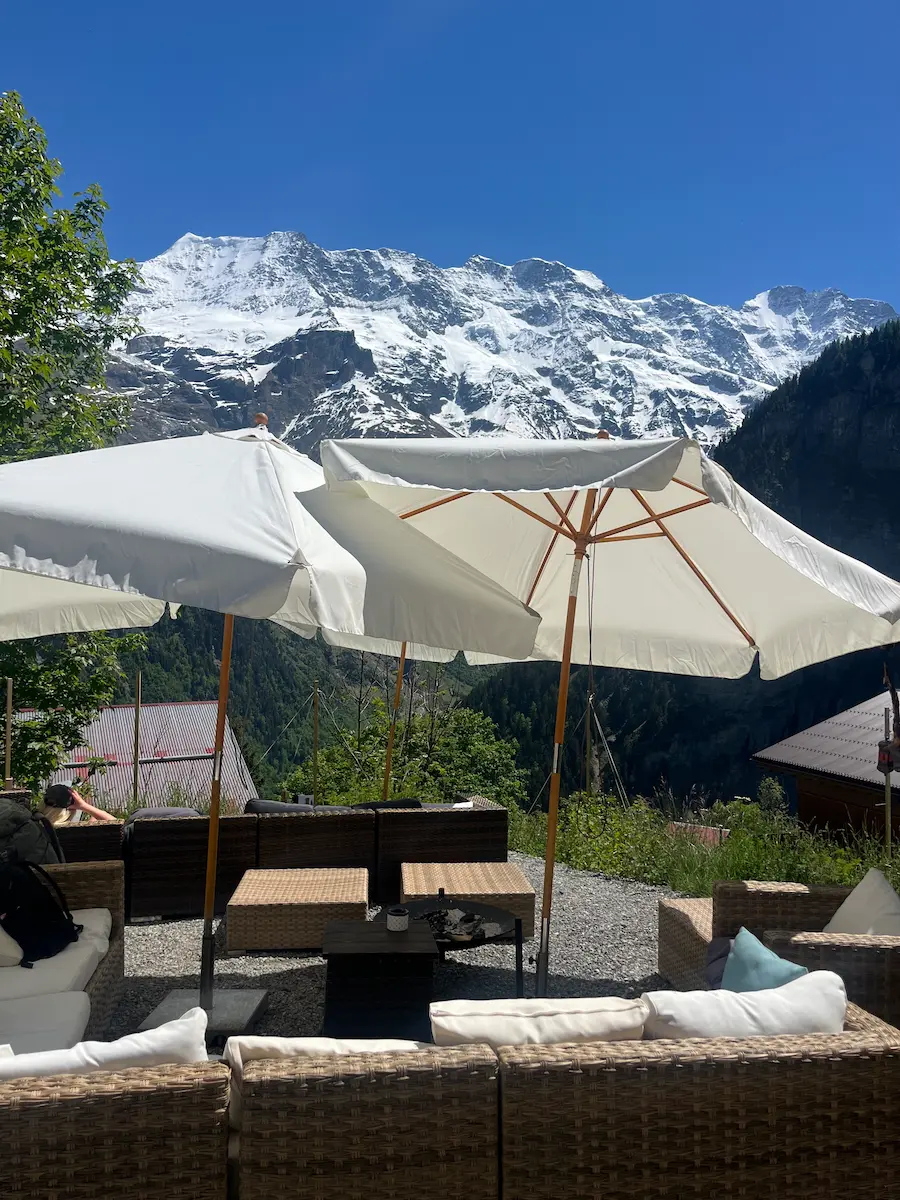
Salads, hummus plates, wood-fired pizza and most importantly cold beer and wine for the adults. We took an outside table with the mountain rising directly across the valley and the village park five steps from where we sat. The kids ate two bites of pizza, ran to the slide, came back for two more bites, ran back to the slide. We watched them and we didn't get up. The grandparents settled in. The waiter didn't hurry us. For the first time since we'd arrived in Switzerland, the day stopped happening to us and started happening for us.
After lunch we walked through Gimmelwald to the Honesty Shop — the local landmark where you leave money in a tin for whatever you take. The kids chose small carved animals. Then we headed back to Wengen.
The kids played in the field by the station while we picked up takeout from Pasta and More and tarts from Bäckerei-Konditorei bakery on the main street. The Wengen strawberry tart is famous locally. Buttery pastry, vanilla cream, fresh fruit, eaten with cold rose wine on the balcony after the kids had gone to bed. One of those small evening rituals that ends up defining a trip.
Day 4: The Royal Ride and the Royal Walk — What to Expect with Limited Mobility Travellers and Toddlers
The Wengen–Männlichen cable car (c0vered by BOP) has an option in summer to ride on the open-air balcony on the cabin's roof. They call it the Royal Ride. It costs 5 CHF per person extra. Worth every franc.
This was a first for all of us. The grandparents had never done a roof-of-a-cable-car experience and were nervous-then-delighted in equal measure. The kids were just delighted. Wind, full panoramic view, the village shrinking below. We did it on the way up and took the regular cabin back down.
At the top we did the Royal Walk — the gravel path from the cable car station to the summit viewpoint with the crown-shaped platform. It's sold as the easy walk on the mountain, and it is, for most of its length. The final climb to the summit cross is steep enough that my dad — who walked 75 minutes downhill the day before without complaint — had to turn back around 75% of the way up. He sat on the hill and we went on without him.
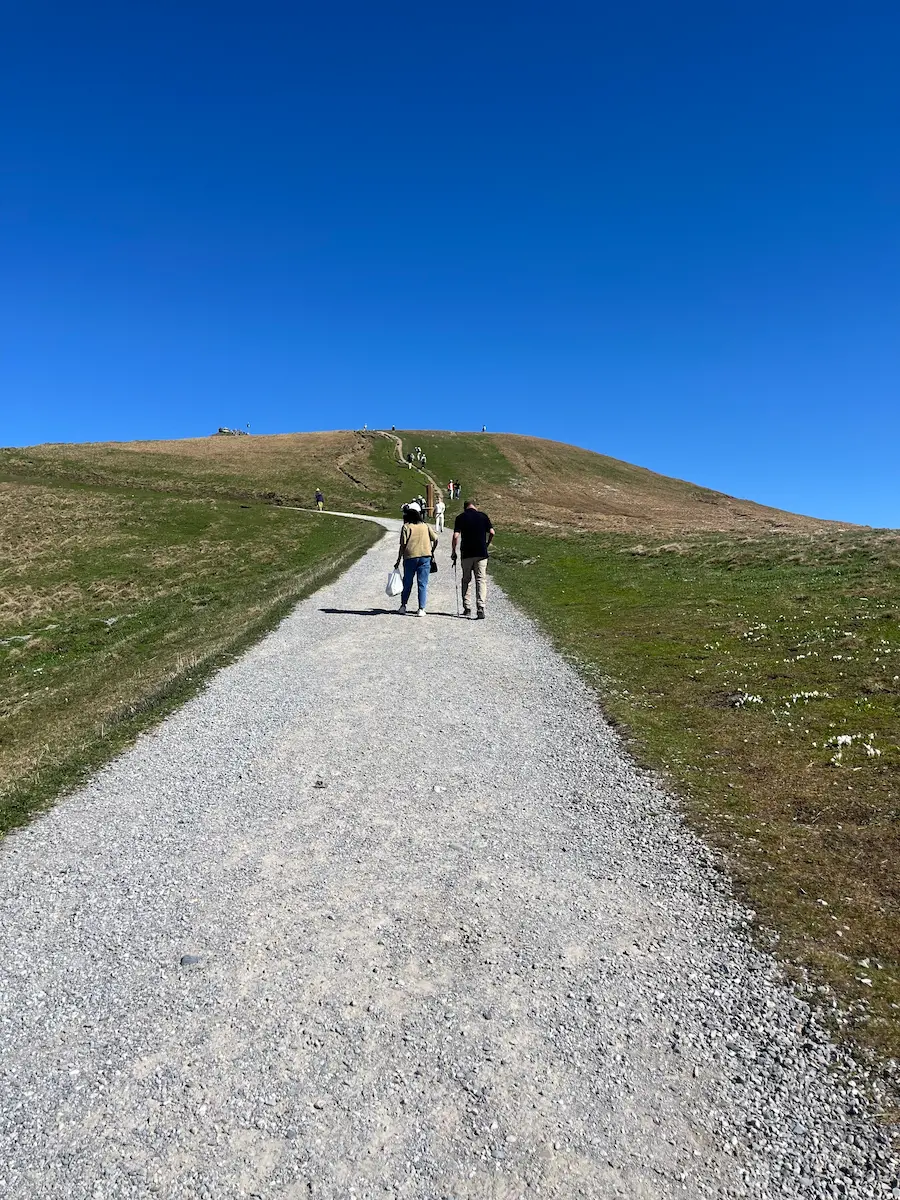
The Royal Walk is not the gentle stroll the brochures suggest. The bulk of it is easy but it's a gravel path. The final summit push is genuinely steep. If your grandparents have any hip or knee issues at all, they will not make the top. The view from where my dad stopped was still extraordinary, he still faced the Eiger across an open meadow, and he had it almost to himself. If you have a toddler, take the carrier, the path is not stroller friendly.
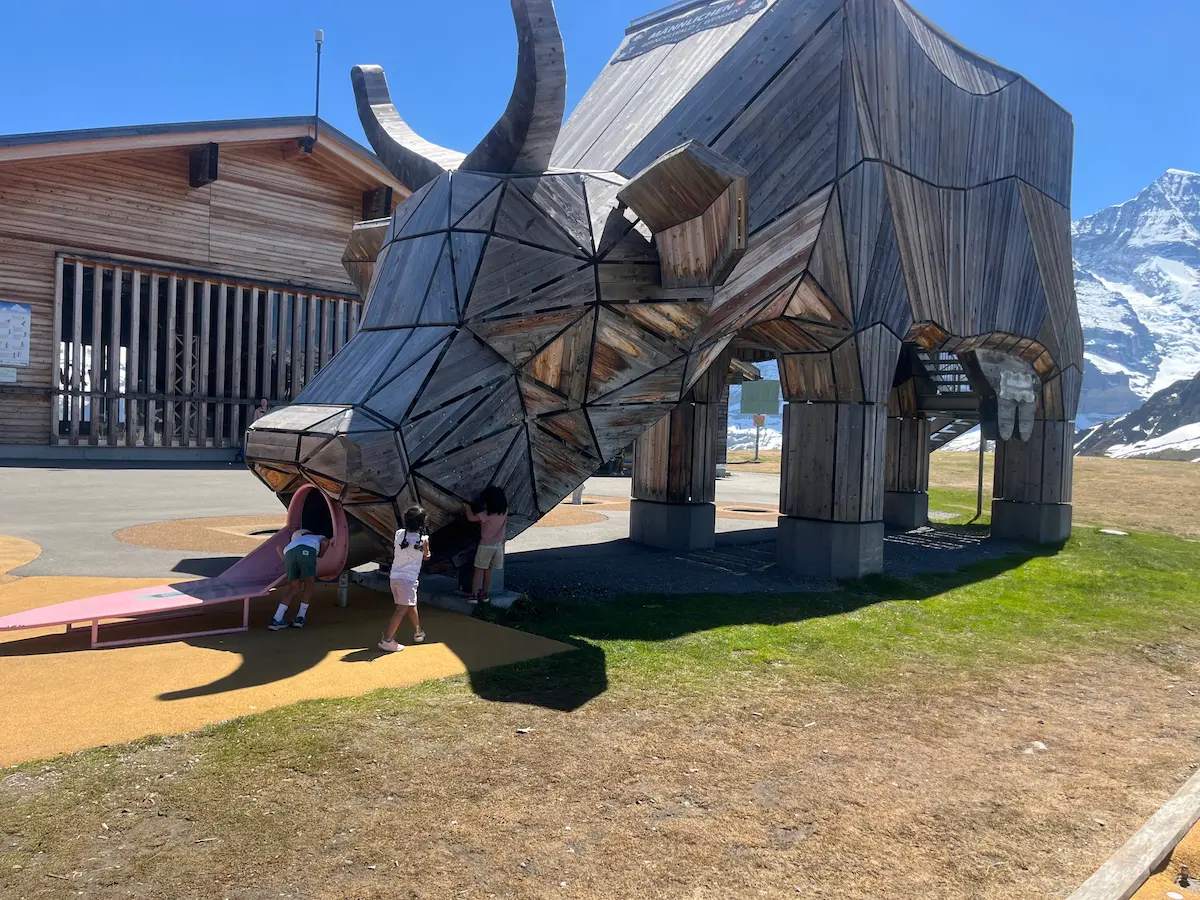
The Männlichen playground was the win for the kids. The giant wooden cow slide deserves its reputation. There's a good cafe with a terrace. Plenty of space to spread out a picnic. Views that make every other playground in your life seem ungenerous.
The Panorama Trail to Kleine Scheidegg — the famous mostly-flat hike that most blogs recommend as the day's main activity — was closed for early-season maintenance. We considered the kids' trail down to Grindelwald instead. But it was the hot part of the afternoon by then, and we'd have ended up needing two trains back to Wengen. We headed back down.
Then we made our one real planning mistake of the trip.
We took the short train from Wengen to Lauterbrunnen to see Staubbach Falls up close. It was hot. The village was packed. The walk to the base of the falls was crowded enough that climbing up to the viewpoint with the kids wasn't viable. And here's the bit nobody warns you about — the train from Wengen to Lauterbrunnen already gives you spectacular views of the falls from above. We added a hot, crowded, transit-heavy hour for a view we'd already seen.
In hindsight, we should have stayed in Wengen and made Day 4 a half-day. We did exactly that for the second half of the afternoon — home by three, relaxing on the balcony, then walking down to the village by a different route. Longer. Scenic. The kind of meandering walk that's only possible when you've stopped trying to fit one more thing in. That walk was the saving grace of the day.
Day 5: Lake Brienz with Toddlers and Grandparents (The Day We Skipped Jungfraujoch For)
Some days are the days you planned. Some days are the days you swapped in at the last minute and ended up remembering for years.
Day 5 was the second kind.
At the end of Day 2, after our first proper logistics-heavy mountain day, we sat on the balcony with a glass of wine and made the call: we were not going to Jungfraujoch. The Top of Europe trip is the iconic Jungfrau region experience — the cog railway tunnel under the Eiger, the highest railway station in Europe, the Ice Palace, the famous Sphinx Observatory. It is also a full day of altitude, queues, transit, and expense. None of those four things suited our family.
We replaced it with Lake Brienz — the lake we'd seen from the panoramic train on arrival day and never stopped thinking about.
We headed down to Interlaken Ost and caught the 11.07 sailing of the Lötschberg steam boat (covered by BOP). An hour each way across the lake to the town of Brienz at the eastern end. The boat was busy — May, sunny, peak weekend traffic on the Brienzersee.
Then we discovered the part of this day that nobody else had written about.
The entire lower deck of the steam boat is a supervised children's play area, manned by a member of the crew. You sign your children in at the door. You leave them there with toys and activities. You go upstairs and you have a coffee and you watch the lake go past for an hour. They come and find you when they're ready.
Upstairs was hot and busy, and the relief of one hour without three children attached to us was a luxury I am still grateful for. The grandparents sat with us. They loved the old-world engineering of the steam boat as much as the views. The water on the Brienzersee is the colour you don't believe until you see it. Kayakers in the distance. Small wooden boats moored against the shore. Mountains that drop straight into the lake. None of the photos do it justice.
In Brienz we walked along the shore and found a quiet stretch of grass for our picnic.
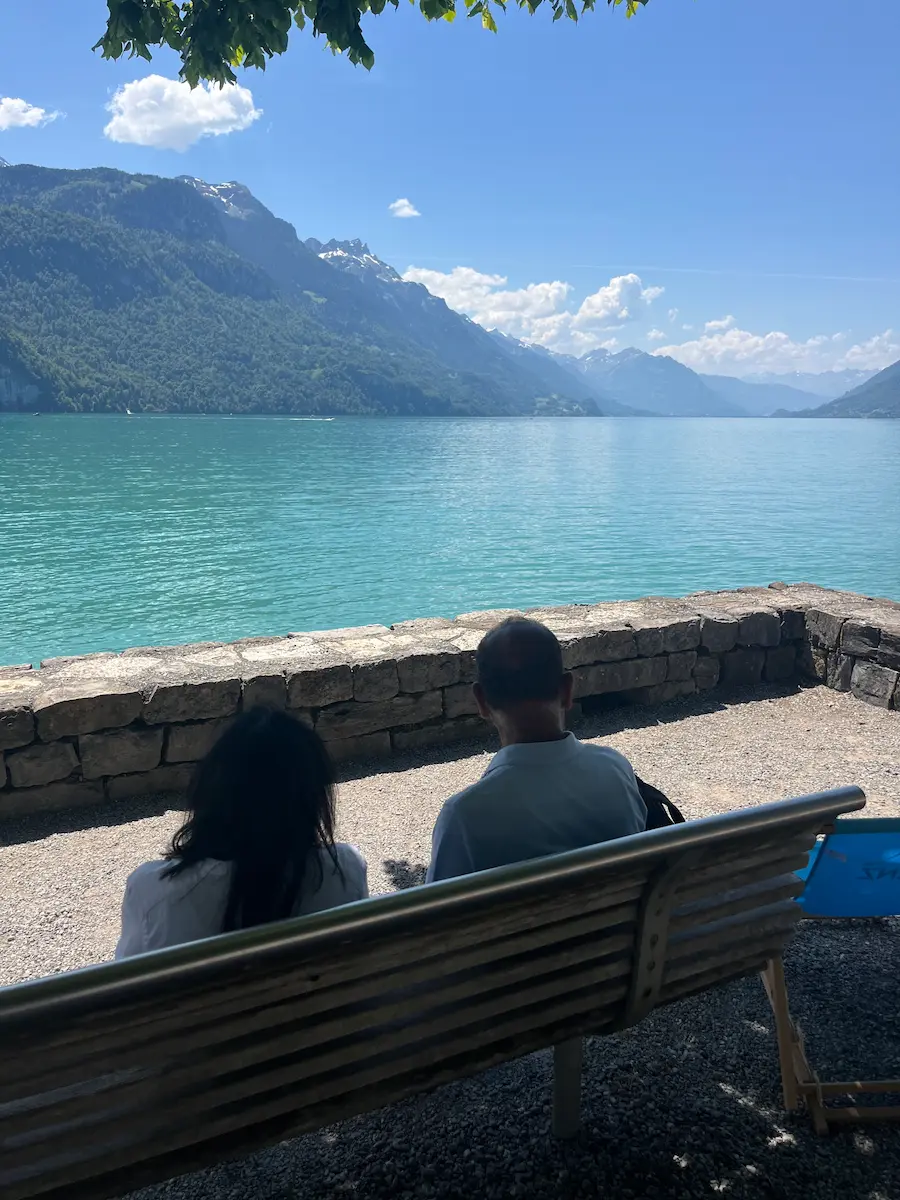
My parents found a bench about fifty metres further along — old wood, set back from the water, facing directly across the lake. They sat on it for nearly an hour. They didn't say very much. I have a photograph of the backs of their heads with the lake stretched out in front of them. It is the most peaceful image I have of either of them in any country we have ever been to together.
The kids ran ahead. My husband and I walked behind them and talked, quietly, about coming back one day — renting a waterfront apartment for a month, swimming in the lake every morning, sliding into the local rhythm. Brienz is the kind of place that puts that thought into your head whether you came planning to or not.
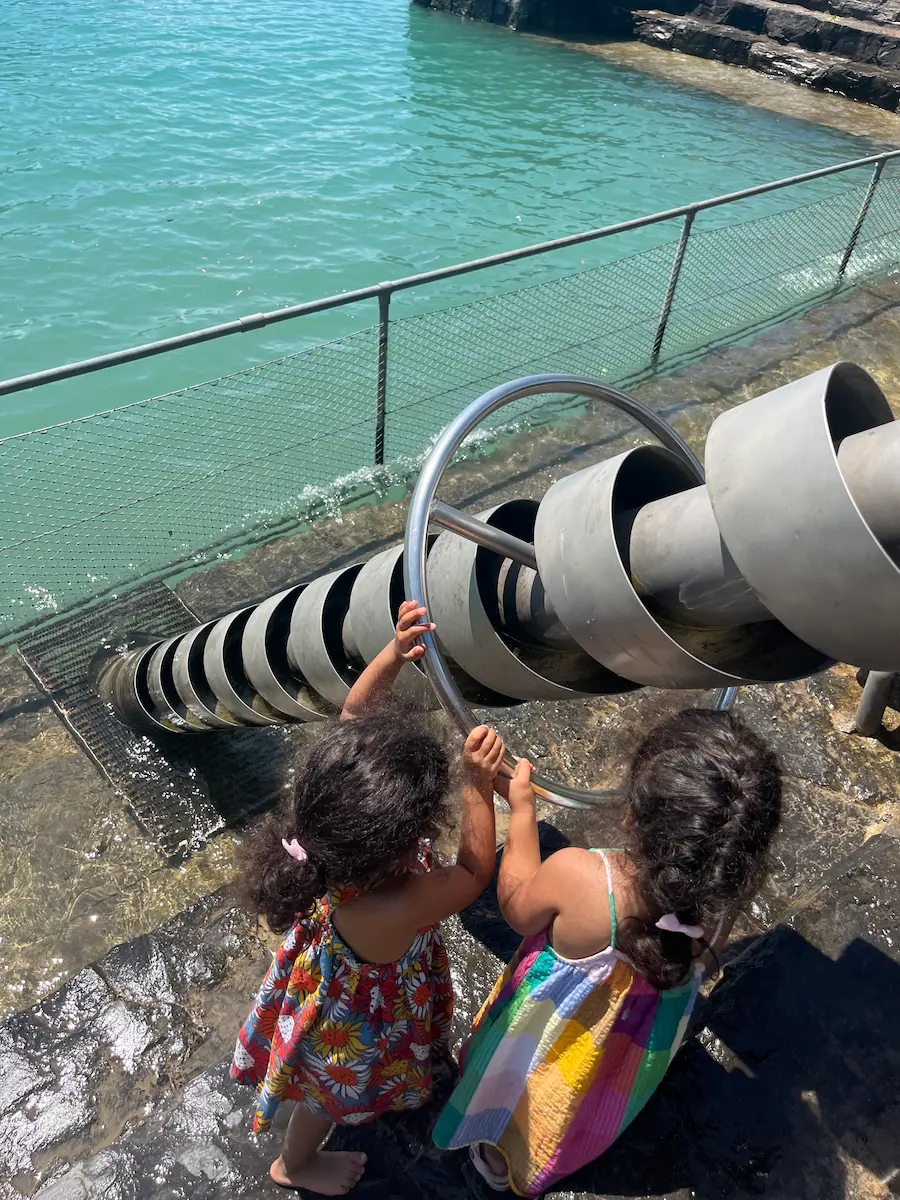
About fifteen minutes' walk from where we disembarked, away from the train station, there's a gated water play park right at the lake's edge. The play structures sit with their feet in the lake itself but the gating keeps children safely contained. We didn't have swimwear. They got soaked anyway and didn't care. This is the kind of facility I have never seen at a lake in the UK, and the kind of thing that makes Switzerland with small children quietly remarkable.
We headed back to Wengen, went home, relaxed, then walked down to the village for dinner at Da Sina. Italian, on the main street. We sat outside with mountain views and the kids ate pasta and we drank wine and the grandparents told the twins they could choose their own pudding.
This day deserves a post of its own. We'll write it later this year — for now, what matters is what we noticed afterwards. We had skipped the most famous experience in the region and replaced it with a quiet lake we'd glimpsed from a train. It turned out to be the best day of the trip.
Day 6: Schilthorn, the Birg Thrill Walk, and Allmendhubel — A Multi-Generational Family Day
If Day 5 was the lake day, Day 6 was the mountain day done at sensible scale. Schilthorn (covered by BOP) was our Jungfraujoch swap — a high-summit experience at a fraction of the time and the effort.
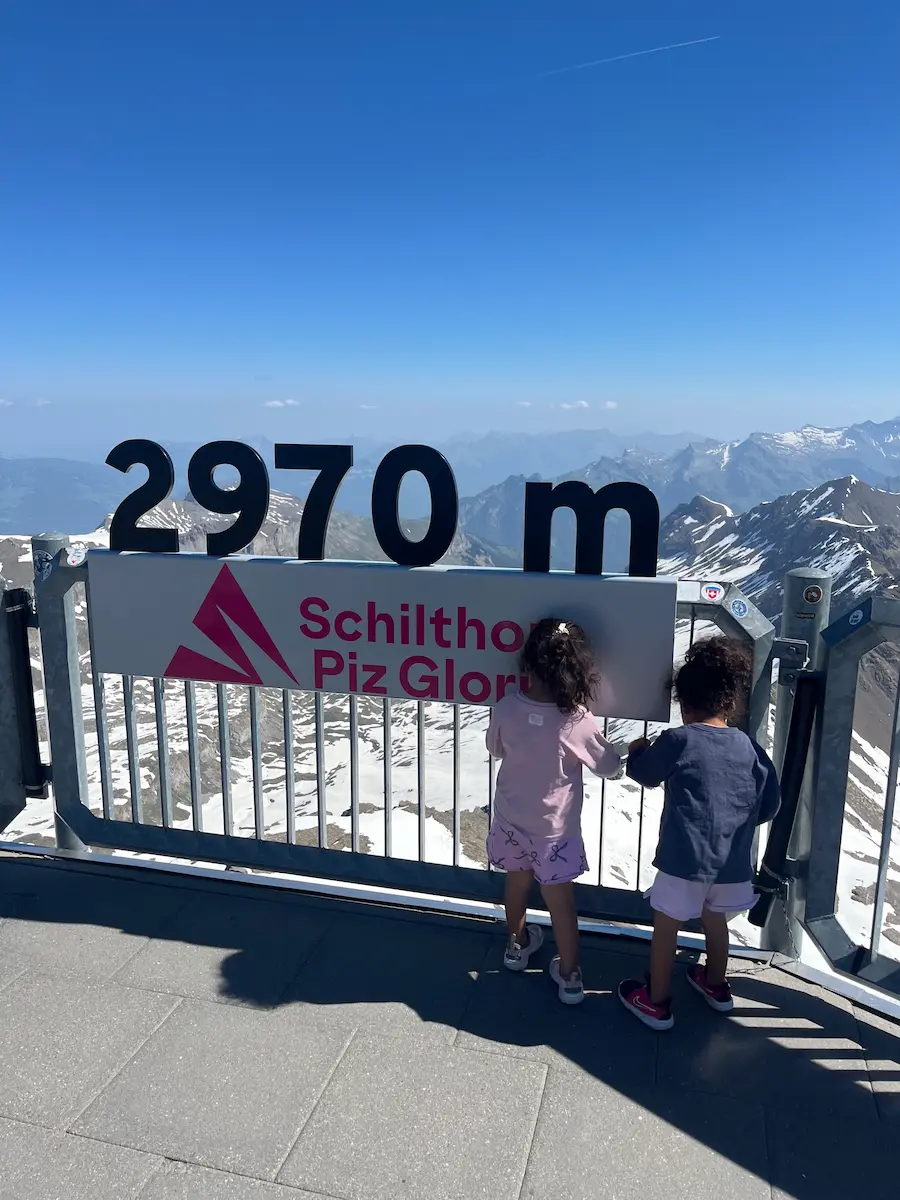
The cable car from Mürren up to Schilthorn (c0vered by BOP) takes about 30 minutes via Birg, the mid-station. The summit is at 2,970 metres — almost as high as the Jungfraujoch viewing platform — and the observation deck takes in 200+ mountain peaks on a clear day. Including the Eiger, Mönch and Jungfrau trio from a different angle than you see them from Wengen.
A real and surprising note: we did not need coats.
At nearly 3,000 metres, in May, we walked around the summit in t-shirts. This may have been our luck. If you're going in June, July, or August, assume the same and pack the same — sun protection, hats, light layers. The cold-weather warning every other blog gives you is a winter warning. Summer mountain temperatures at altitude in the Jungfrau region are warm. Often hot.
The Piz Gloria revolving restaurant is the famous Schilthorn experience — slowly rotating panoramic dining, made famous by the Bond film On Her Majesty's Secret Service. It was closed during our visit, as was the Bond World exhibition. We hadn't realised these have seasonal opening hours. Worth checking the schilthorn.ch site before you go.
The summit cafe was open. The Bond memorabilia around the building is enough that any fan of that era will get the cultural reference. My parents are exactly the right generation for that film — it was the highlight of Schilthorn for them as much as the view was.
On the way down we stopped at Birg for the Skyline View ledge and the Thrill Walk. The Thrill Walk is the suspended platform with glass floor sections and exposed walkways bolted to the cliffside below the cable car station. It looks more terrifying than it is. Our twins did the whole thing and loved it. Birg also has wide stone steps to sit on with the same view as the Skyline ledge — a quiet detail that matters when your grandparents need a moment.
Back in Mürren we took the funicular up to Allmendhubel (c0vered by BOP). The playground at the top is properly epic — wooden play structures, slides, a small water play area that was welcome in the heat. We sat at the cafe and ate and watched the kids. The famous Allmendhubel Flower Trail had no flowers on it — May is too early in the season. Worth knowing before you go. We started the trail, realised the situation, turned around, and went back to the playground.
We headed back to Wengen mid-afternoon. The kids and grandparents had an early dinner at Da Sina. My husband and I sat with them, had one glass of wine, walked everyone back to the apartment, put the kids to bed — and then went out for dinner. Just the two of us.
We sat at an outside table at the bottom of Wengen's main street, ordered slowly, and didn't talk about logistics for the first time in five days. The grandparents were reading on the balcony when we got back. The kids hadn't stirred. This is the part of multi-generational travel nobody tells you about — the evening you forgot you were allowed to have.
Day 7: Departure Day Done Right (Lindt Home of Chocolate on the Way to Zurich Airport)
Most departure days are a wash — checkout, hours of transit, airport, flight. We turned ours into the trip's bookend.
We left Wengen mid-morning and headed for Kilchberg, the lakeside village just outside Zurich that is home to the Lindt chocolate factory and museum. The detour adds about two hours to your departure day. It is worth every minute.
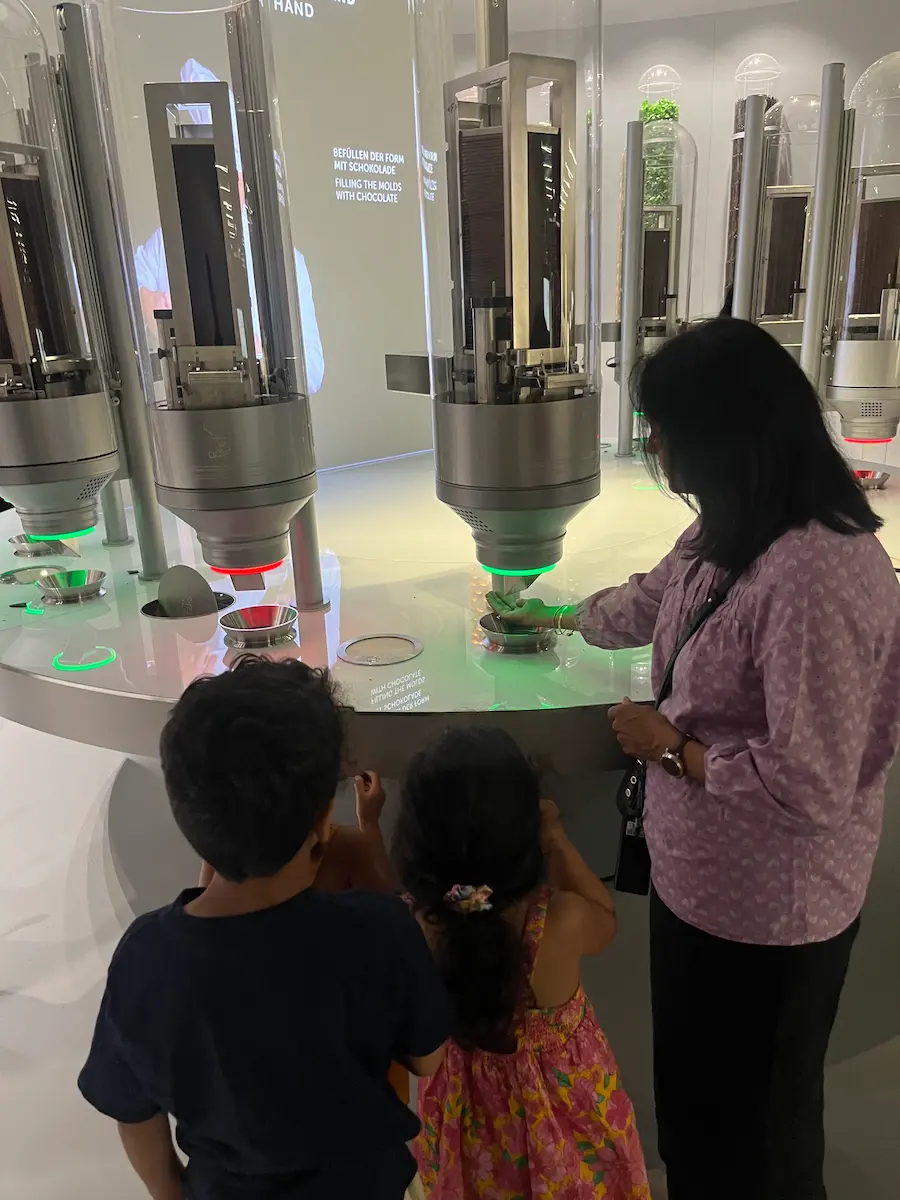
We'd booked our 11am slot in advance, tickets sell out weeks in advance. Book yours before you go. Stored our luggage at the Lindt cloakroom for free — this is the unlock most departure-day visitors don't realise — did the audio tour,stuff ourselves with unlimited tastings, then took the direct train from Kilchberg straight to Zurich Airport.
The Lindt Home does several things well that make it perfect for a multi-gen group. Kids are free. Grandparents get a pensioner rate. The audio tour is kid-friendly. The tasting room is genuinely all-you-can-eat. We watched the grandparents discover this and slowly turn into children. There is something specific about chocolate-tasting-until-you-feel-sick that pulls every adult back to age seven. I have a photo of my dad sampling chocolate with a focus I have not seen him bring to any other holiday activity in fifteen years of travelling with him.
Make the grandparents children again. Taste every flavour until you feel sick.
The Interlarken-to-Zurich train was the day's last small revelation. We boarded into the kids' carriage — Swiss intercity trains have dedicated family carriages with a small slide and a play area built directly into the train.
The flight home was the only normal thing about that day. The grandparents fell asleep before takeoff and didn't wake until landing.
The Two Running Themes (Read This Before Booking)
Two things ran through the whole trip and earn a section of their own. If you read nothing else in this post, read these.
The Heat in May (And What This Means If You're Going in Summer)
We went in late May and were caught out by unexpected heat. The forecast suggested around 21°C. The reality was significantly hotter, including at altitude — we did not need coats at 2,970 metres on Schilthorn. Every blog and travel guide we'd read for this trip told us to pack layers and to warn for cold. The result: we overpacked warm kit we never wore, and we under-prepared for sun.
For May travellers: the standard "pack layers, it can get cold" advice is partially wrong. Switzerland in May can be Mediterranean-warm. Pack lightweight clothing, sun hats, sunscreen, and lightweight long-sleeve UPF layers for sun protection rather than warmth. Keep one fleece per person for cooler evenings or unsettled weather. That's it.
For summer travellers — which is when most families come: if late May surprised us with heat, June through August will reliably deliver more of it. Most family travel to the Jungfrau region happens in the UK and US school holiday window. The heat advice in this post is not a May anomaly. It is the right advice for the entire core travel season for this region. Bring the lightweight kit. The fleece can stay home.
What we used and would use again: sun hats for every member of the family, a sunscreen brush applicator for the kids, kids' sunglasses with retainer straps so they don't lose them, lightweight UPF long-sleeve layers for the kids, soft water pouches refillable at every Swiss public fountain.
What we wished we'd had: a Snooze Shade for the stroller for sun cover, a clip-on stroller fan for the buggy, handheld fans for the older kids and grandparents. We didn't pack any of these because we hadn't expected the heat. If we went again — and certainly if we went in summer — every one of them would be in the bag.
Why Logistics Are the Hidden Cost of the Jungfrau Region
The Jungfrau region is gorgeous specifically because it's stitched together by a precise mesh of trains, cable cars, funiculars, and buses. That web of connections is also its highest cost in time and energy.
A typical full day in this region involves three to six transit legs. A train down. A train across. A cable car up. The activity. The reverse on the way home. Each transition involves a tight platform change, a ticket validation, a moment where someone needs the toilet, and a moment where someone has gone in the wrong direction.
With grandparents and toddlers, every transition is a small drain. By the end of a six-transition day, you are exhausted in a way that has nothing to do with the activity at the top of the mountain.
We learned this on Day 2 — Cliff Walk plus Grindelwald lunch plus Pfingstegg, with two trains and two cable cars each way. By the time we got home, we were broken. The plan-then-skip cycle (we'd had Bort in the original plan and dropped it on the day) was the only reason we made it through.
After Day 2 we changed our default approach. One big thing per day. Home by 4pm.
That rhythm worked. The Brienz day was one big thing. The Schilthorn day was one big thing with two add-ons we could absorb because the activities flow naturally from the same cable car system. The Männlichen day broke our rule by adding Lauterbrunnen in the afternoon, and boy did we regret it.
The other thing nobody writes: your grandparents will struggle to navigate these connections independently.
Swiss train timing is to the minute. Platform changes happen in 1-3 minutes. You need to know your next platform before you get off the current train. If you're travelling with older parents on this kind of trip, build the trip so that one logistics-confident family member is with the group at every transition. Do not split the group across separate trains. Do not send them on ahead to "meet you there." It is not the place to discover that your dad cannot read the SBB app at speed.
Swiss Family Infrastructure: Things Nobody Wrote About But We Couldn't Believe
Three things repeatedly took us by surprise across the week. None of them appear in the standard family travel guides for this region. All of them quietly made the trip better.
The kids' carriage on Swiss trains. Many Swiss intercity trains have dedicated family carriages sign-posted with a bear with built-in play areas — small slides, soft play, seating arranged for groups with children. They are not signposted from the platform. You find them by walking through the train. Worth the walk every time.
The supervised kids' play area on the Lake Brienz steam boat. Detailed in Day 5 above. The entire lower deck of the BLS Brienzersee steam boats is a supervised play area staffed by a member of the crew. You sign your kids in. They play. You rest. Not advertised in any guide I read before the trip.
The free public water fountains everywhere. Swiss villages and trail networks have continuously running public drinking fountains fed by alpine springs. The water is exceptional. Pack soft water pouches instead of single-use bottles and refill at every fountain you pass. We did not buy a single bottle of water in seven days for a family of seven.
There are also discounts and concessions for families that the standard pricing pages don't always show — Swiss Family Cards make children travel free with a paying parent on trains, pensioner rates are common at attractions, the Berner Oberland Pass bundles regional transport at a discount. Always ask at the ticket counter.
Top Tips for Switzerland with Elderly Parents, Grandparents, and Toddlers
- Base yourself in one place. Wengen worked for our group. Grindelwald, Mürren, or Lauterbrunnen also work depending on priorities. Moving accommodation mid-trip with this many people is its own logistics tax. Don't do it.
- One big thing per day, home by 4pm. The recovery rhythm is the difference between an enjoyable week and a broken one. Build in the slack.
- Buy the Berner Oberland Pass. It covers nearly all the trains, cable cars, and steam boats you'll use in this region. Worth the upfront cost for almost any 4+ day visit.
- Skip Jungfraujoch with this kind of family. The Top of Europe is a famous experience and a long, expensive, altitude-heavy day. We chose Schilthorn and Lake Brienz instead and didn't regret it.
- Underestimate the heat at your peril. May surprised us. June to August will reliably be warmer. Pack for sun, not for cold.
- Bring soft water pouches, not bottles. Swiss fountains are alpine-fresh and free. Refill, don't buy.
- Pack a picnic lunch from Coop before you head out. Eat when you want, not when you can. A morning Coop shop is time well spent.
- Check opening status the night before every travel day. Cable car and trail closures are common in May and September. A 30-second website check saves replanning on the platform.
- Don't book unreserved seats on the Lucerne–Interlaken Express in shoulder season. Plenty of unreserved seating. Save the reservation fee.
- Plan your departure day around Lindt. The Lindt Home of Chocolate at Kilchberg is a 12-minute train ride from Zurich HB and offers free luggage storage. It adds about two hours to your departure day. Worth every minute.
- Eat at Da Sina in Wengen at least once. Italian, on the main street, outside tables with mountain views. We went three times in seven days. They are still in our family group chat.
- Twins on the floor of a cable car is fine. Multi-gen days are long. Kids will end up sitting in unconventional places.
What to Pack for the Jungfrau Region with Toddlers and Elderly Parents
Everything in this list earned its place on the trip. Nothing here is padding.
For the journey
- Travel pillows — the Zurich to Wengen transfer involves several train changes. Worth it for grandparents and children alike
- Kids wireless headphones — essential for the flight and long train legs
- iPad cover with headrest straps — hands-free screen time on the train
- LED writing pads — quiet activity for toddlers that doesn't involve a screen
- Magnetic travel game pack — works on any flat surface, doesn't scatter pieces across a train carriage
- Slimline battery pack — the SBB app lives on your phone. Don't let your phone die on a mountain platform
- Multi-compartment snack box — we prepped this from Coop every morning. Kept the day running without stopping for food every hour
For the mountains
- Walking poles — non-negotiable for elderly parents on any descent. The Mürren to Gimmelwald walk especially
- Toddler backpack carrier — for the Cliff Walk and any section where a toddler needs to be carried safely on an exposed path
- Lightweight travel stroller — Wengen is car-free and the village paths are manageable. Useful for tired toddlers at the end of a long day
- Soft water pouches — fill at every opportunity. The heat surprised us and hydration on mountain platforms matters
Sun protection — take this seriously May felt like August. If you're visiting in summer, plan accordingly.
- Sun hats — for the whole family, every day
- Sunscreen brush applicator — easier to apply to wriggling toddlers than a tube
- Kids sunglasses with retainer straps — UV reflection off snow-capped peaks is real even in May
- Clip-on stroller fan — for the hottest days when the stroller becomes a heat trap
- Handheld fans — grandparents and parents both used these on the cable car queues
Footwear
- Hiking boots — proper ankle support for the Mürren to Gimmelwald descent and any mountain path. Trainers are not the same thing
- Crocs — the instant-on shoe for village evenings, cable car stations, and anywhere the boots come off
Layers and weather
- Lightweight rain shells — mountain weather in the Jungfrau region changes without warning. Pack one per person, they weigh nothing
Essentials
- Universal travel adapter — Switzerland uses Type J plugs. Not compatible with UK or EU adapters. Don't discover this at midnight in Wengen
- Travel first aid kit — plasters, antiseptic wipes, children's paracetamol. The one you only think about when you need it and don't have it
Practical Information
Best months for this itinerary: Late May to early October for summer travel. June, July, and August are warmest and busiest. September offers fewer crowds with usable weather. Mid-May to early June carries some risk of maintenance closures on cable cars and trails — we hit two during our trip.
Regional transport pass: Berner Oberland Pass (BOP). Covers most trains, buses, cable cars, and the Lake Brienz and Lake Thun steam boats in the region. Available for 3, 4, 6, 8, or 10 consecutive days.
Getting around: Train and cable car only — no car needed or wanted. Wengen is car-free.
Currency: Swiss Franc (CHF). Cards accepted nearly everywhere. Small cash useful for honesty shops and some mountain cafes.
Language: Swiss German is the local language; English is widely spoken in tourist areas.
Accommodation for multi-gen families of 6-7: Apartments beat hotels for cost, kitchen access, and shared space. Look for 3-bedroom options with washing machine and balcony.
Restaurants we recommend: Da Sina (Wengen, Italian, main street) — outside tables with view, kid-friendly, reasonable. Mountain Hostel (Gimmelwald) — lunch with mountain view, kid-friendly park next door. Pasta and More (Wengen, takeaway) — useful for end-of-long-day pickups.
Bakery: the Bäckerei Konditorei bakery on Wengen's main street, famous locally for its strawberry tarts. Buy them in the afternoon. Eat them on your balcony after the kids are in bed.
Planning Your Trip: What Reads Next
This itinerary works hardest when you read it alongside the rest of our Switzerland cluster:
- For the full apartment review and the case for Wengen over Grindelwald: Where to Stay in Wengen for Multi-Generational Families
- For a full breakdown of every activity in the Jungfrau region — what works for elderly parents, what works for toddlers, and the ones nobody writes about — read our Jungfrau region activities guide.
- Getting around the Jungfrau Region is its own planning challenge — passes, cable car connections, and the one rule that saved the second half of our trip. Full guide here: Getting Around the Jungfrau Region with Grandparents and Toddlers.
We proved this multi-generational approach in Canada first. If you're considering a similar trip on a different continent, our 7-Day Canadian Rockies Itinerary with Toddlers and Grandparents covers the same family at a different scale.
Cloud Kissed Adventures — aspirational but accessible luxury travel for families who refuse to stay home. All recommendations are personal experience: nothing sponsored, everything tested with a four-year-old on my hip and a 72-year-old on a cable car balcony. This post contains affiliate links for products and services I genuinely used and loved. If you book through them, I may earn a small commission at no extra cost to you. Thank you for your support — it keeps these guides free and detailed for families like yours.