Icefields Parkway with Toddlers and Grandparents: A Multi-Generational Family Guide
Driving the Icefields Parkway with toddlers and grandparents? Here's exactly how we did it — what worked, what we got wrong, and the Yoho detour worth making.
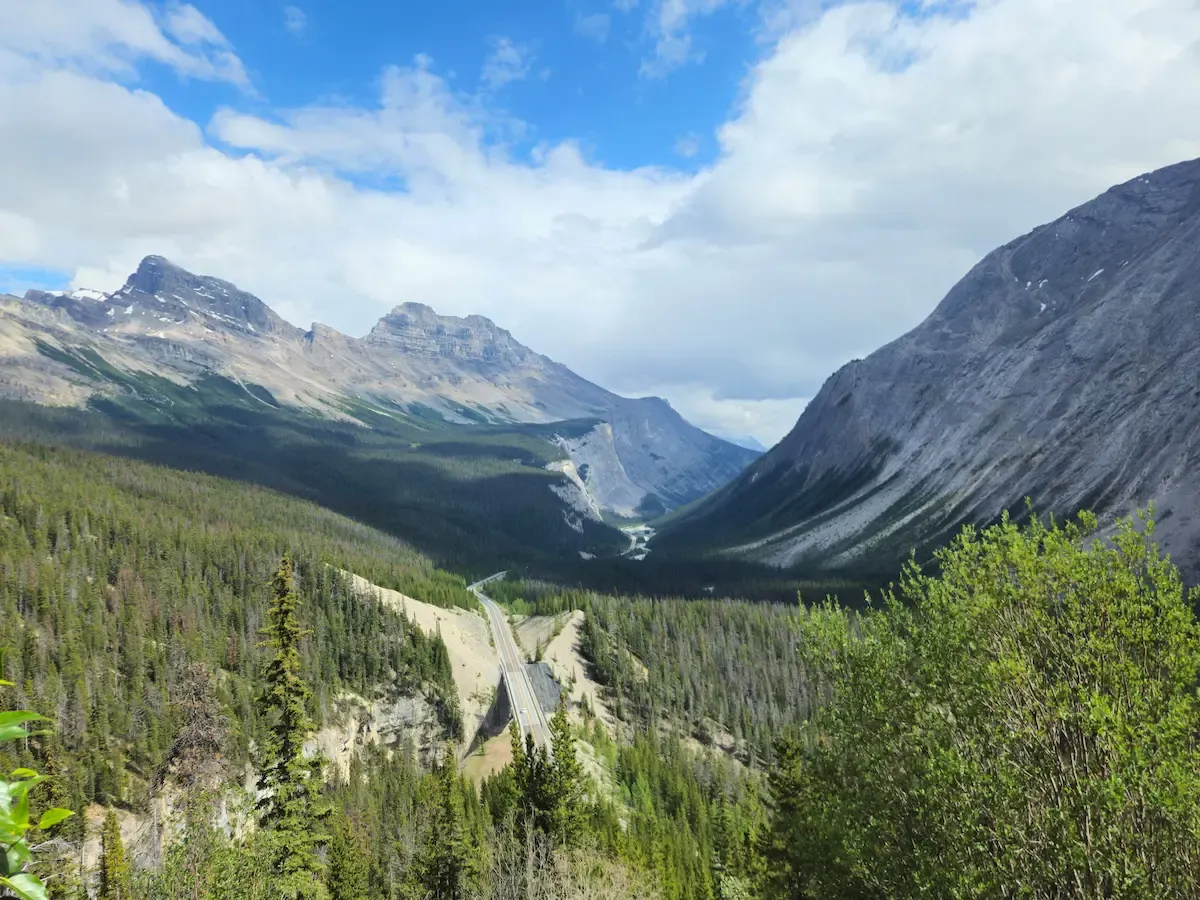
Seven people. Three under six. Two grandparents in their seventies. 232 kilometres of mountain road between Banff and Jasper. Here is the honest version of driving the Icefields Parkway with a multi-generational family — what worked, what we got wrong, and what we would do exactly the same way again.
This post contains affiliate links
In This Guide:
- Renting a Car for the Icefields Parkway
- Can You Drive the Icefields Parkway in One Day?
- Best Icefields Parkway Stops with Kids
- Pacing the Icefields Parkway with Toddlers
- Where to Stay: Banff and Jasper
- Top Tips
- Practical Information
- Planning Your Drive
Renting a Car for the Icefields Parkway
The Icefields Parkway is one of the world's great drives. It is also over 200 kilometres of mountain road with limited cell service, one service stop, and no public transport that works for a family of seven. The vehicle you book at Calgary airport is not a logistics detail. It is the decision that shapes every day of the trip.
We booked a Chrysler Pacifica — a 7-seater with sliding doors, three rows, and a boot large enough for 2 strollers, a toddler carrier, bags for seven people, and a Safeway shop. It cost more than a standard estate. It earned every dollar back across six days.
Three things mattered more than I expected.
Sliding doors. Strapping twin toddlers into car seats at altitude, in cold morning air, in parking lots with limited space, with grandparents trying to climb into the row behind — sliding doors transform this from a daily ordeal into something that takes ninety seconds.
Third-row seating. Two adults in the front. Three kids in the middle row. Two grandparents in the back. Everyone in the same vehicle, no convoy driving, no separated families, no one twin in one car and the other twin in another. For a multi-generational trip this is the single most important thing the vehicle does.
Boot space. The Pacifica swallowed 2 lightweight strollers, a toddler backpack carrier, large suitcases, walking poles, and a Hydro Flask the size of a small child without anyone having to negotiate which item came on which day. Repacking the car six times a day is the unspoken reality of road-tripping with three under six. The right boot makes it possible.
Can You Drive the Icefields Parkway in One Day?
Yes — but probably not the way you are thinking.
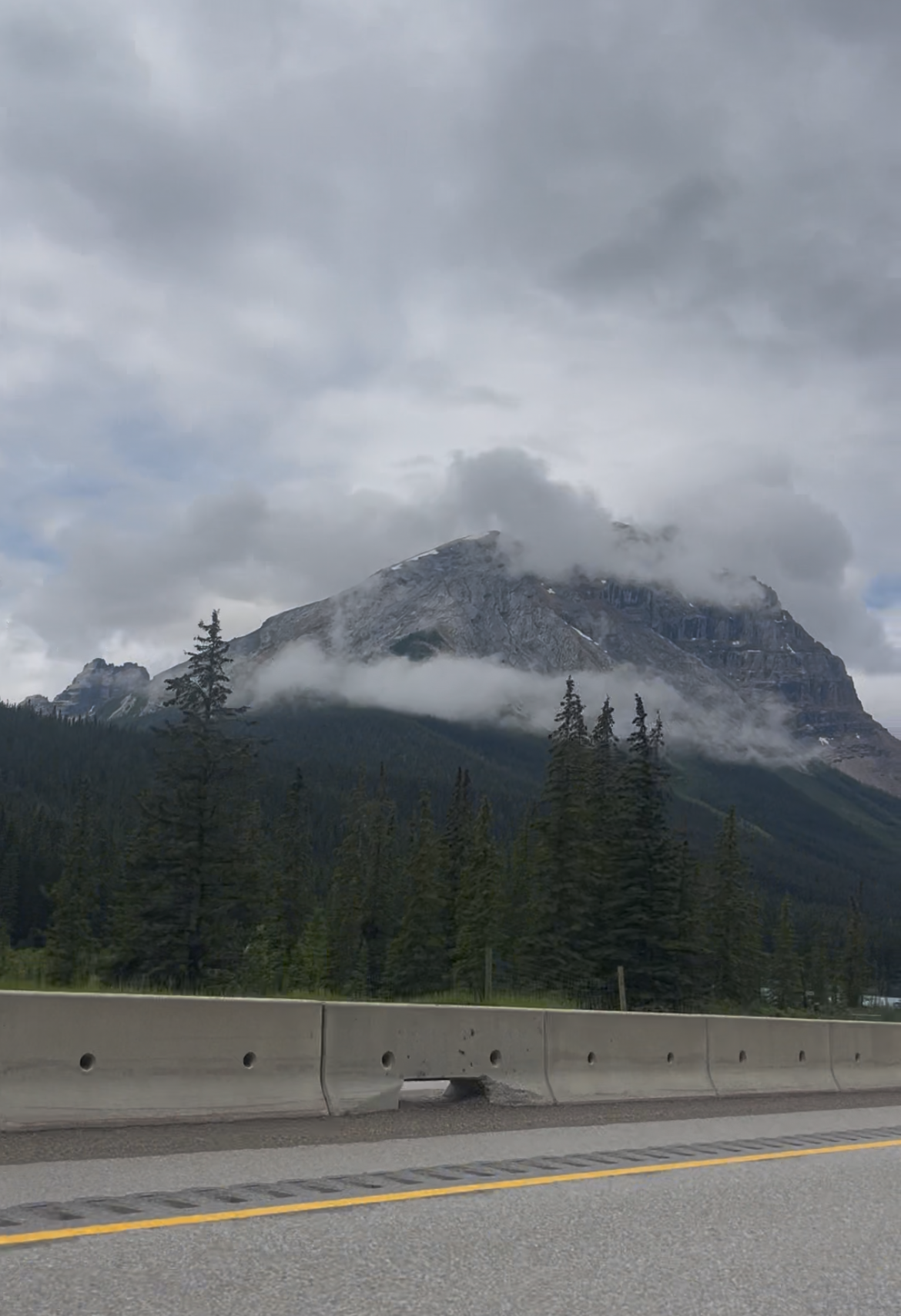
The Icefields Parkway runs 232 kilometres between Lake Louise and Jasper. The map says three hours and twenty minutes of driving. The reality, with a family of seven and a list of stops worth making, is closer to seven or eight.
The question is not really whether it can be done in one day. The question is what kind of one day.
Doing the Parkway return — Banff to Jasper and back — in a single day is genuinely punishing. You are looking at ten to twelve hours in the car, no time to absorb the stops, exhausted toddlers, irritable grandparents, and the persistent feeling that you drove the world's most beautiful road past every viewpoint at speed.
The version that worked for us was a one-way drive: Banff to Jasper, with two nights at the Jasper end before driving back south via a different route. The Parkway became a day of stops rather than a day of driving. We left Banff after breakfast, made every major stop we wanted to make, arrived in Jasper before dinner, and felt like we had actually been on the drive rather than survived it.
For multi-generational families with toddlers, two nights in Jasper at the end of the Parkway is the single biggest pacing decision you can make. The Parkway then becomes the experience it is sold as. Everything stops feeling rushed.
Is the Icefields Parkway Scary to Drive?
Genuinely no — and I say this as someone whose mother was nervous about it before we set off.
The road is wide, well-maintained, paved the entire length, and gentle in its gradients. There are no cliff-edge sections, no hairpins, no unpaved stretches. In summer conditions, it is one of the easier mountain drives you will encounter — easier than most Alpine passes.
Two practical caveats: cell service is limited to non-existent along most of the route, so download offline maps before you leave. And fill the tank before you start. There is one fuel stop on the entire 232km route, and you do not want to discover this near empty.
Best Icefields Parkway Stops with Kids
Every guide to the Icefields Parkway lists the same stops. We made each of them. What follows is the honest multi-generational version of each one — what worked, what didn't, what to know before you arrive.
Emerald Lake (The Detour Worth Making)
Before the Parkway proper, a confession: we did not drive straight north out of Banff. We detoured west into Yoho National Park to spend an hour at Emerald Lake. It added forty minutes to our drive day and was the best decision we made all week.
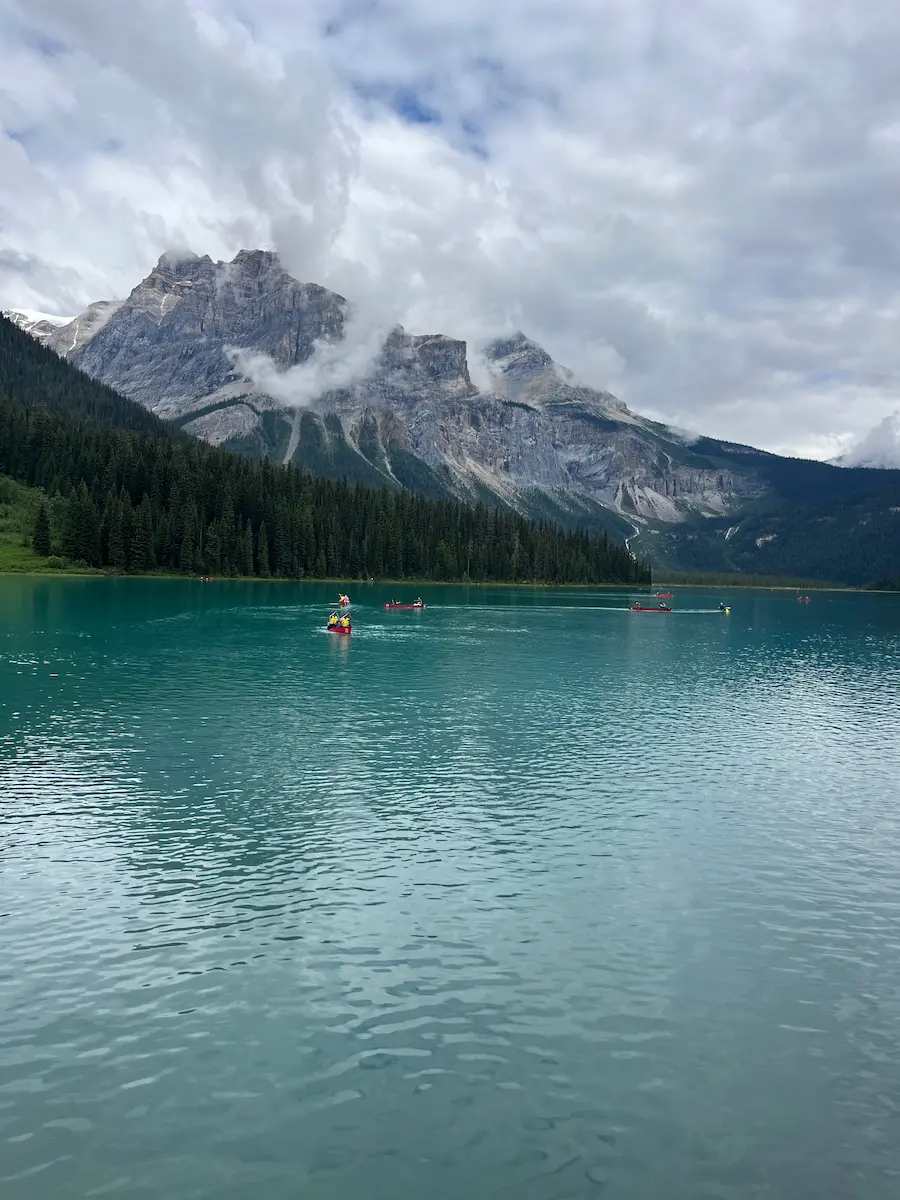
Emerald Lake sits about thirty minutes off the Trans-Canada Highway near Field, BC. The canoe rental at the lodge boathouse runs from late morning. The lake itself is small, calm, and ringed by mountains in a way that makes the famous Banff lakes look almost showy by comparison. For a multi-generational family it has one thing none of the other Rockies lakes offer in the same way: it is genuinely usable. The canoes go out without a queue. The grandparents can sit on the shore comfortably. The water is calm enough that even nervous parents will let a five-year-old in a boat.
My son, husband and I took a canoe out across the water. My son in his life jacket, gripping the side of the canoe with both hands, completely silent for the first minute and then completely unstoppable for the rest of it. From the middle of the lake we could see my parents on the shore with the twins, who were sitting side by side in their strollers and waving with both hands every time we caught their eye.
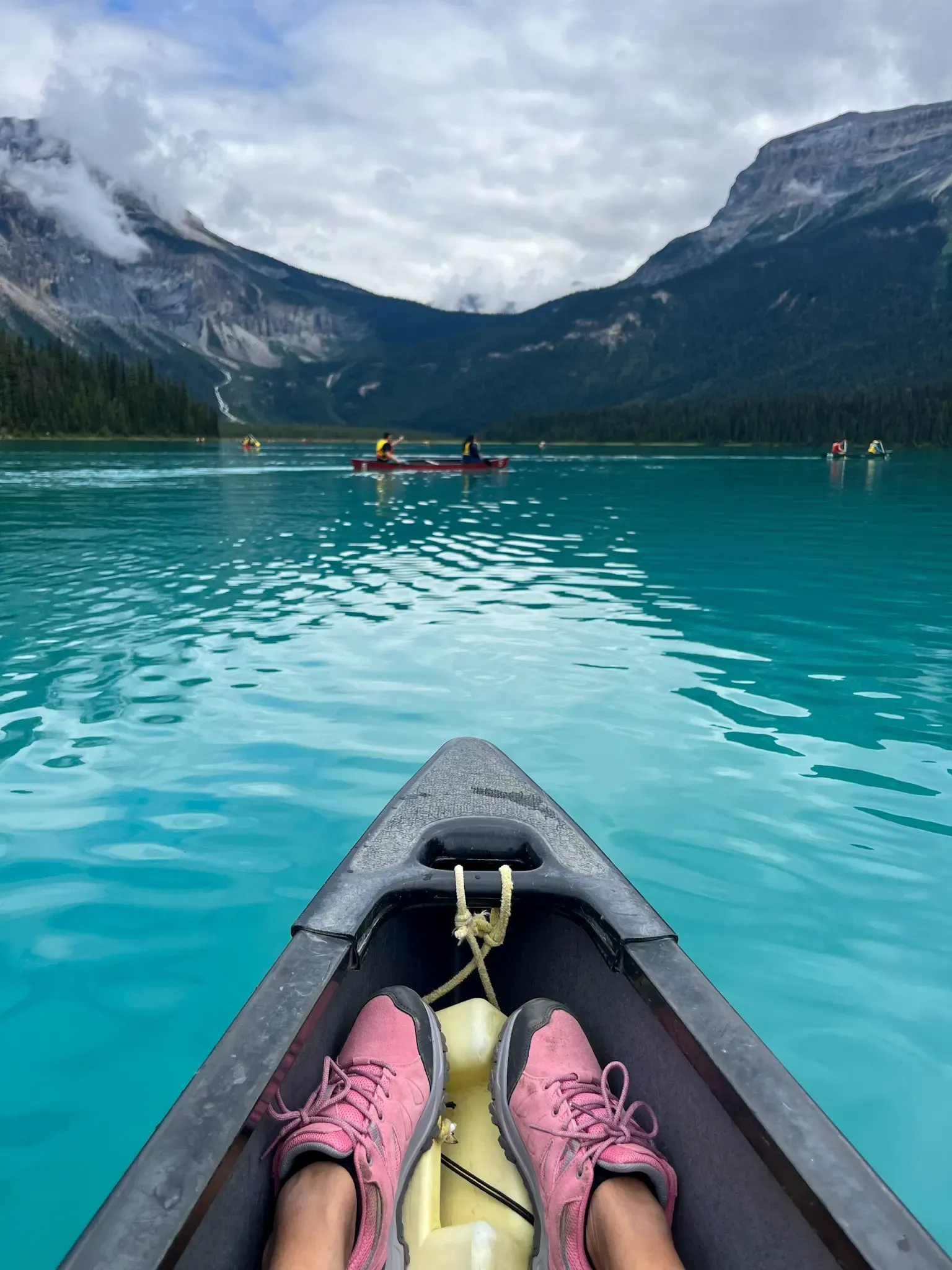
This is the image that will stay with me forever — twin toddlers waving from a shoreline ringed by mountains, my parents next to them, my son in a boat with me on the calmest water in Canada.
My twins sat side by side on the shore with their grandparents and waved at us in the canoe like they hadn't seen us in months. We had been gone for ten minutes. That was the moment I knew the detour was worth it.
Bow Lake
The first major stop heading north from Lake Louise. Bow Lake is the gentle introduction — a wide, glacier-fed lake with a roadside pull-in and a flat path along the shore. Stroller-accessible. Walking-pole friendly. The mountain reflections on a still morning are extraordinary.
For a family of seven this is the right first stop. Easy enough that the grandparents can stretch and walk without negotiating terrain. Manageable enough for twin toddlers to be unstrapped and let loose at the lake edge without anyone having a heart attack. Beautiful enough that even after several days in the Rockies it still earns its place.
Peyto Lake Viewpoint
Peyto Lake is the photograph. The one on every Canadian Rockies guidebook cover. The impossibly turquoise crescent surrounded by mountain peaks.
It is also — and this matters enormously — one of the few major Icefields Parkway viewpoints that is properly stroller-accessible. The path from the upper parking area to the viewpoint has been paved and graded in recent years. With a lightweight stroller, twin toddlers, two grandparents on hiking poles, and a five-year-old who wanted to run ahead, we made it to the viewpoint together. As a family of seven. With nobody left behind in the car park.
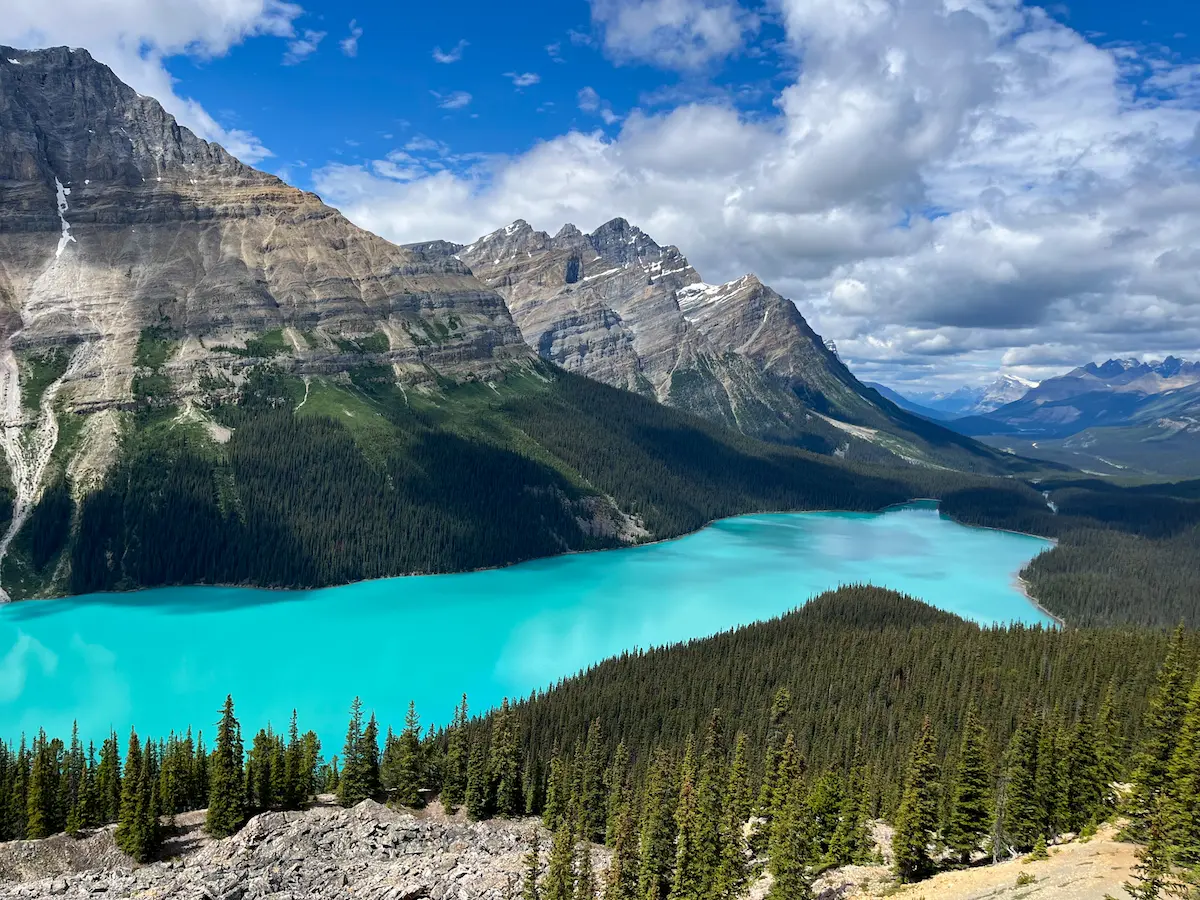
We saved Peyto for the way back — driving south on our last day in the Rockies. After Moraine Lake, after Lake Louise, after the glacier, after days of being told this was the country of impossible blues, we stood at the Peyto viewpoint and could not believe there was still something more perfect than everything we had already seen. The bluest blue. The last view of the trip. All of us soaking it all in for one last time.
After everything we had already seen in the Rockies, we drove home via Peyto Lake. The bluest blue. Somehow still the most extraordinary view of the trip.
Saskatchewan River Crossing
The only service stop on the entire 232km route. Petrol. Bathrooms. A café. A gift shop. Oh and the yummiest pretzels and popcorn to satisfy your 5 year old. Almost every guidebook either ignores this stop entirely or notes it as a logistics box to tick.
For a multi-generational family with young children, Saskatchewan River Crossing is a different kind of stop entirely. It is the mid-drive reset.
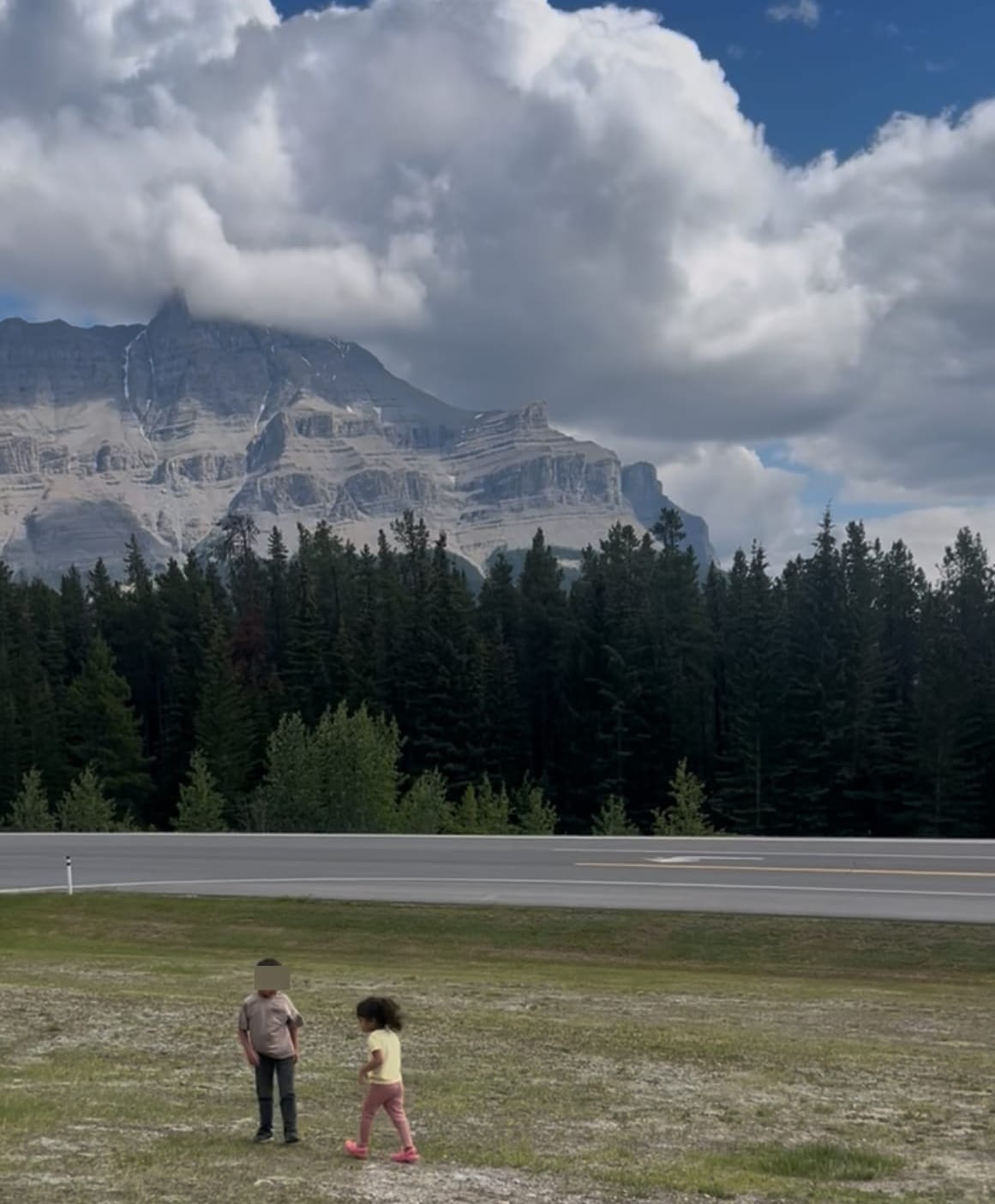
The image I will keep from that day: all three kids out of the car, stretching their legs on the patch of grass, the mountains rising directly behind them, the twins finally free of their car seats, my son leading them on some game of his own invention. Grandparents on a bench nearby. Adults stretching. Everyone, for ten minutes, exactly where they needed to be.
You will not find this written in a guidebook. But for a family driving the Parkway with toddlers, the service stop with a view is not a logistical waypoint. It is the moment that makes the drive sustainable.
Columbia Icefield and the Athabasca Glacier
The big one. The most photographed stop on the Parkway. The reason a lot of families make the drive in the first place.
Here is what we got wrong: we did not book the Ice Explorer tour in advance. The Ice Explorer is the specialised all-terrain vehicle that takes you out onto the glacier itself. It books out months ahead in peak season. By the time we tried to add it, every slot for the day was gone.
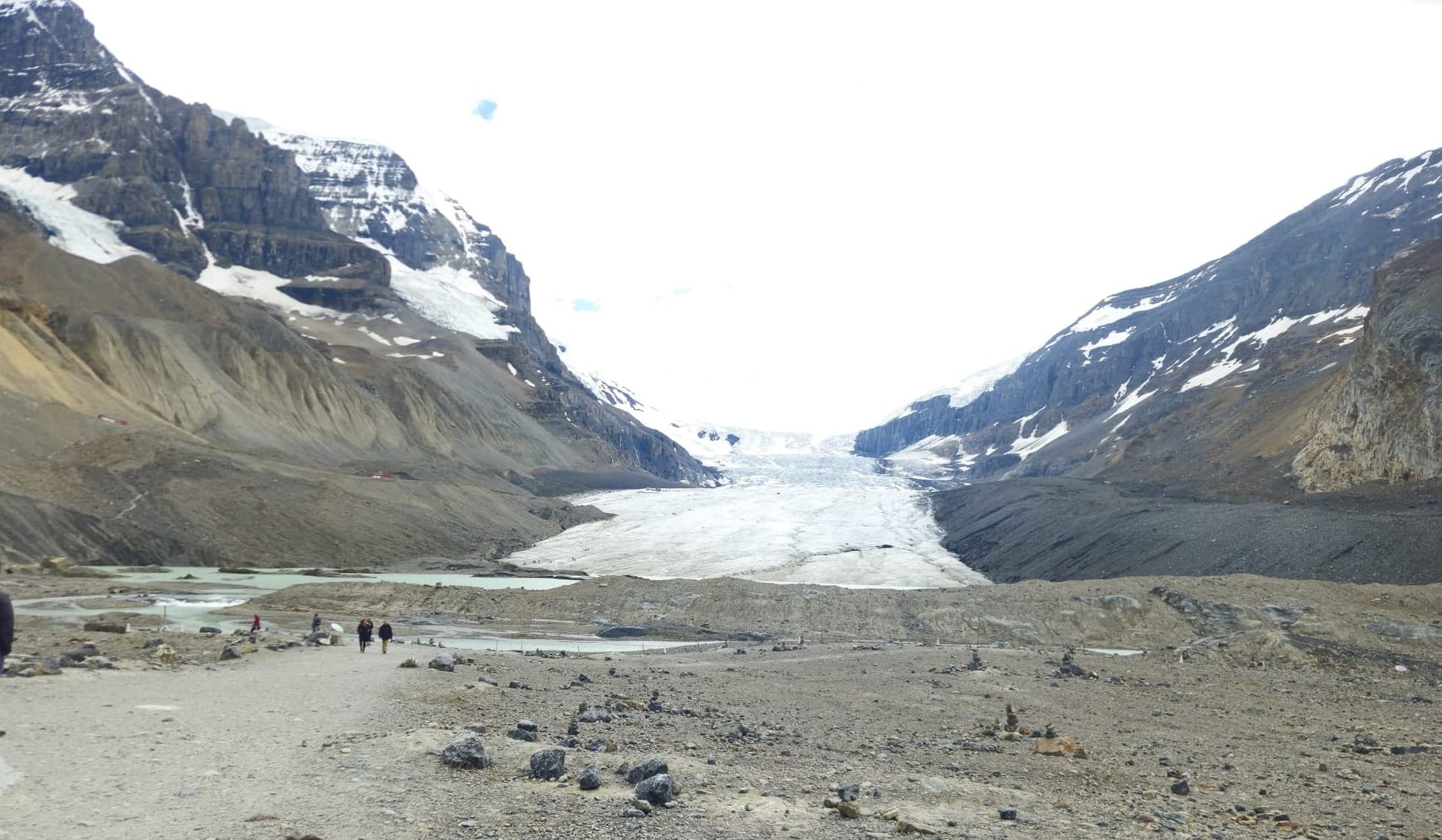
So we attempted the walk ourselves. Park in the Columbia Icefield Discovery Centre car park. Cross the road. Follow the marked gravel path up the moraine to the glacier toe. It is roughly a kilometre each way, uphill on loose gravel, exposed to wind. With twin toddlers and grandparents in their seventies, a few of us gave up after 30 minutes. But my husband and son went ahead.
And honestly — they loved it. My 5 year old spent the next hour in the car making us all jealous and asking why we didn't get to go in the super cool truck (Ice Explorer).
Should we have booked the Ice Explorer? Yes. Did it ruin the day? No. The Ice Explorer offers the closer access, the guided commentary, the not-walking-uphill-on-gravel-with-toddlers and grandparents element. But the walking version is doable if you can't get a slot and an hour or so to spare.
Sunwapta Falls
The quietest of the major Parkway stops. Smaller crowds than Athabasca Falls. A short, flat walk from the car park to the falls viewpoint over a bridge across the gorge.
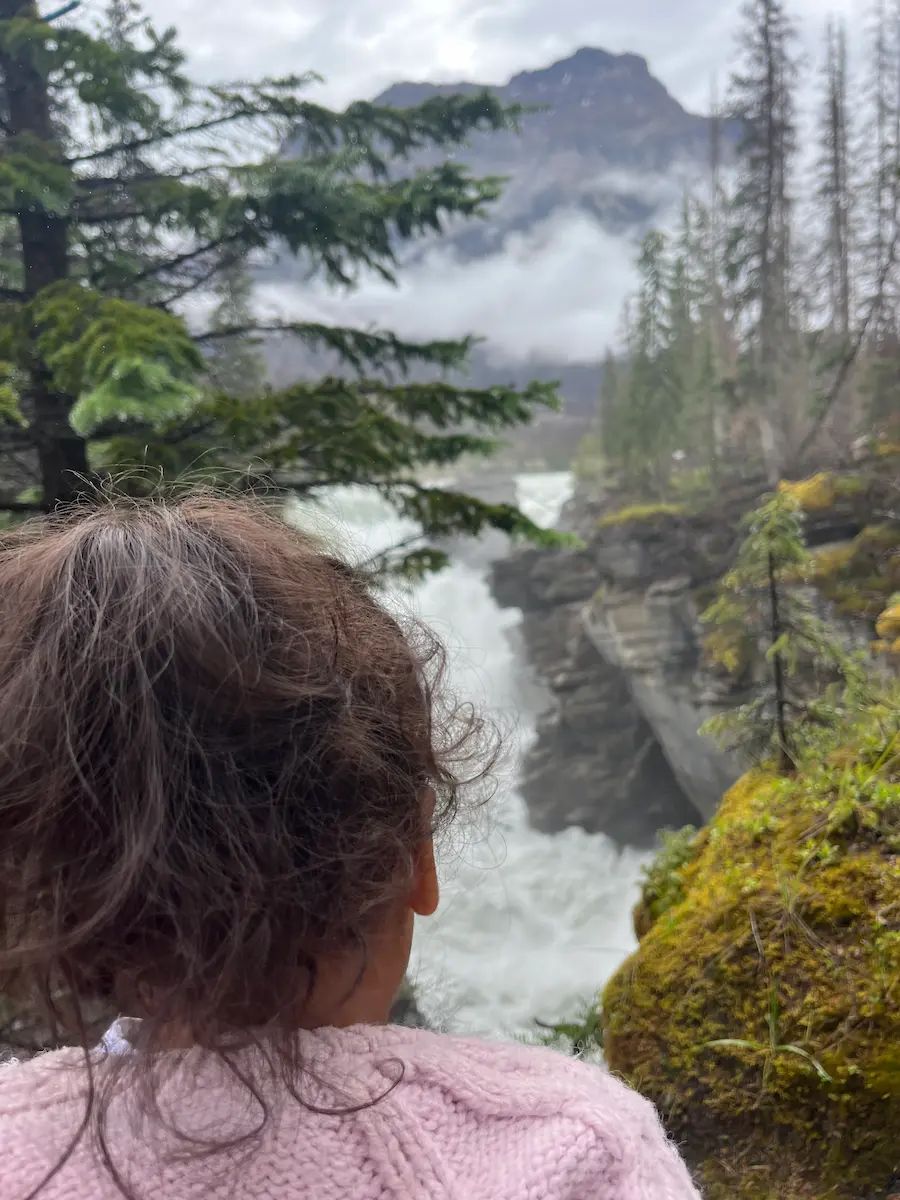
For a family of seven, Sunwapta is the perfect afternoon stop — easy enough that everyone walks the same path together, brief enough that it doesn't eat the day. The falls are dramatic without being deafening, the bridge gives the kind of viewpoint that feels properly mountain-y, and there is a small lodge with coffee if grandparents need a sit-down moment.
Athabasca Falls
The last major stop before Jasper. Bigger than Sunwapta, louder, more powerful — and the one stop my son still talks about.
The setup is perfect for young children: a wide loop of paths and bridges around the falls, with viewing platforms at multiple levels, including one near the base where the noise and spray are at their full intensity. My twins ran the loop. Then ran it again. And again. Free, loud, surrounded by the magnificent falls, completely in their element.
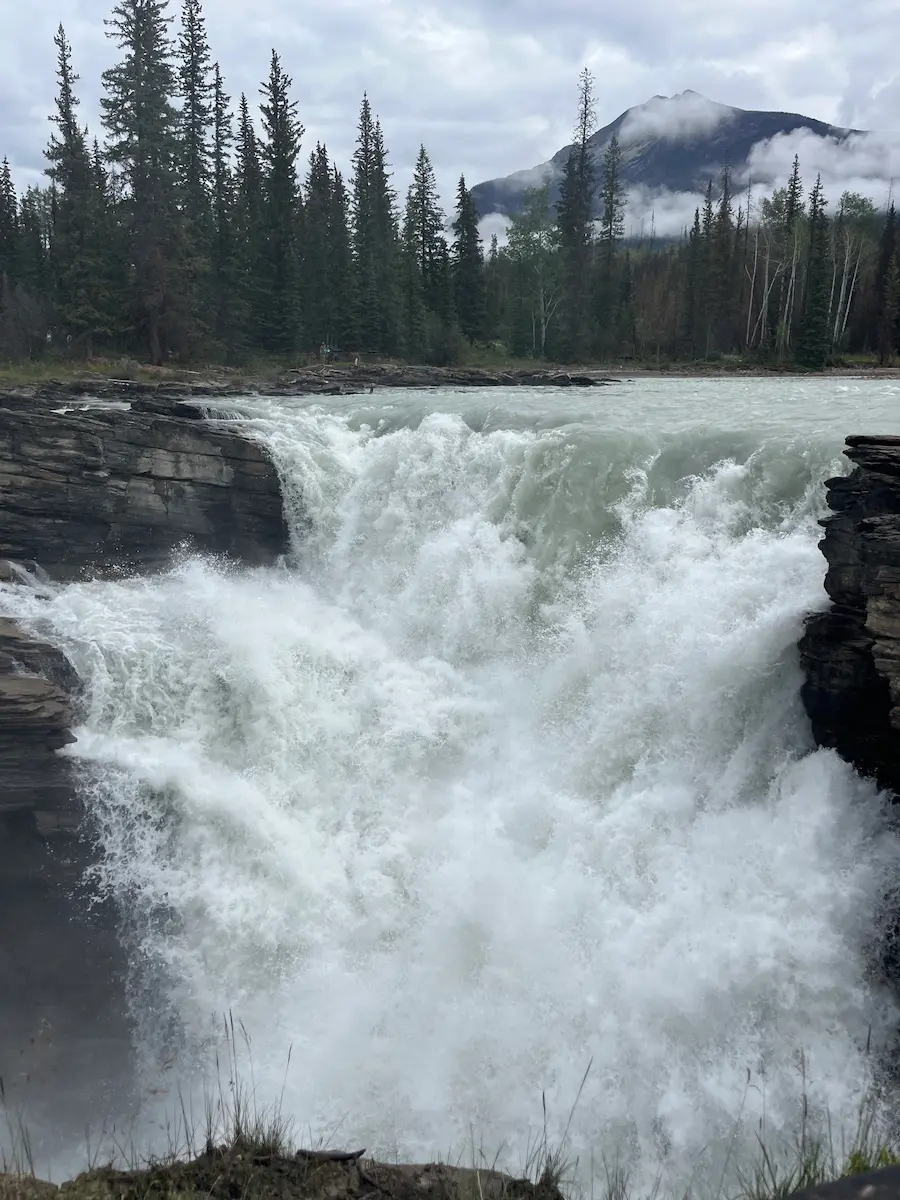
There are some stairs on the lower loop which can be tricky with a stroller — leave it in the car or do the upper loop only. Either way works.
Athabasca Falls was the loudest place we had ever been. My twins ran the loop, came back, told us it was the best stop, then ran it again.
Pacing the Icefields Parkway with Toddlers
Here is the honest pacing reality: it is a long day. There is no version of the Icefields Parkway with twin toddlers and grandparents that gets done quickly.
What works is breaking it up. Planning your stops in advance so you know roughly when the next one is coming. Front-loading the snacks. Backloading the iPad. And quietly hoping the kids fall asleep for at least one of the longer driving stretches.
The rhythm that worked for us: drive forty to sixty minutes. Stop for fifteen to thirty. Drive forty to sixty. Stop for fifteen to thirty. Repeat for seven hours.
The kit that made it sustainable: a multi-compartment snack box filled the night before with grapes, crackers, breadsticks, fruit pouches, and a small treat per child for emergencies. An iPad cover with headrest straps — the back seat became a private cinema for the dullest twenty-minute stretches between viewpoints. Wireless headphones for the kids so the front seat could navigate without a cartoon soundtrack. LED writing pads for the moments when even the iPad wasn't enough. Travel pillows for the inevitable mid-afternoon naps.
For the grandparents, the bigger comfort items: compression socks for the long sitting hours, a thermos of tea from the hotel before we set off, and the front passenger seat by rotation so everyone got the best view at some point in the day. A portable charger lived in the door pocket for phones drained by photography.
Where to Stay: Banff and Jasper
The Icefields Parkway is bookended by two very different bases. Where you stay either end shapes the whole drive.
Banff end. We stayed at Hotel Canoe & Suites in Banff town — superior suite with two queen beds, mountain views from the balcony, an outdoor thermal pool, and a location that put us on the right side of town for an early Parkway start. Our full honest review covers why it earned its place for a multi-generational family — including the thermos-fill ritual that became our morning routine before every drive day. Read the full Hotel Canoe review here.
Jasper end. We stayed at The Crimson Hotel Jasper — a comfortable, well-located base for a multi-generational family arriving off the Parkway. Walkable to Jasper town, large enough rooms for the seven of us across connecting configurations, and the kind of unfussy, family-friendly luxury that worked for grandparents and toddlers alike. The Fairmont Jasper is more iconic — but for a family of seven coming off a seven-hour drive, the Crimson was the right call.
Top Tips
- Book the right vehicle. A premium 7-seater with sliding doors is not an upgrade for a family of seven — it is the foundation. Book at Calgary Airport and book early.
- Drive it one-way. Banff to Jasper with two nights at the Jasper end. Don't try to do it return in a single day with young children.
- Fill the tank before you leave. One service stop on the entire route. Saskatchewan River Crossing has fuel, but it is genuinely the only option mid-route.
- Download offline maps. Cell service is limited to non-existent along much of the Parkway. Google Maps offline mode is your friend.
- Book the Ice Explorer months ahead if you want to do it. We didn't, and we walked the glacier instead — entirely doable, but only one of those options is bookable on the day.
- Save Peyto for the last day. Driving south on the return is the bookend that nothing else gives you. Save Peyto Lake for the very last viewpoint of the Rockies trip.
- Pack the carrier, not just the stroller. The glacier walk is impossible with wheels. The carrier is the kit decision that opens up the harder stops.
- Twenty minutes at Saskatchewan River Crossing. Not five. The service stop is the mid-day reset that makes the drive sustainable for kids and grandparents alike.
- The iPad is allowed. Seven hours of mountain driving is not the moment to be precious about screen time.
- Accept that it will take all day. This is not a transit drive. It is the experience. Leave after breakfast, arrive before dinner, and let the road become the trip.
Practical Information
Distance: 232 kilometres / 144 miles between Lake Louise and Jasper.
Driving time without stops: 3 hours 20 minutes.
Driving time with stops, family of seven: 7-8 hours.
Best time to drive: May to October. The road is technically open year-round but winter conditions make it impassable for general family travel.
Fuel: One service stop at Saskatchewan River Crossing. Fill up before departing.
Cell service: Limited to non-existent along most of the route. Download offline maps before leaving.
Park pass required: Yes — Parks Canada Discovery Pass or daily pass for everyone in the vehicle. Buy in advance online.
Direction: We drove Banff to Jasper and then Jasper to Calgary Airport. Either direction works; the views are equally good both ways.
Stops we made: Emerald Lake (detour into Yoho on the way out of Banff), Bow Lake, Peyto Lake, Saskatchewan River Crossing, Columbia Icefield and Athabasca Glacier, Sunwapta Falls, Athabasca Falls.
Bathrooms: Available at major stops (Bow Lake, Saskatchewan River Crossing, Columbia Icefield Discovery Centre, Sunwapta Falls, Athabasca Falls). Limited or none between.
Hire car: A 7-seat SUV or minivan from Calgary Airport is your base camp for the week. Book early — the right vehicle category sells out in summer.
Planning Your Drive
The Icefields Parkway works best as part of a properly planned Rockies trip. The vehicle, the pacing, the booking decisions — none of them are afterthoughts. They are the foundation on which the trip rests.
Book the rental car as early as possible. Premium 7-seaters sell out months ahead in peak season — book yours here.
For where to stay at the Banff end, our Hotel Canoe & Suites honest review covers the base that made every drive day possible — including the thermos-fill ritual that made early starts work.
For the full week around this day, our 7-day Canadian Rockies itinerary with toddlers and grandparents covers every stop, every decision and everything we would do again.
For the other Rockies experience worth booking carefully, our honest guide to Moraine Lake with toddlers and grandparents covers the private tour we booked and why we would do it again.
For more multi-generational road trip planning, our Switzerland with toddlers and grandparents itinerary.