Getting Around the Jungfrau Region with Grandparents and Toddlers: The Honest Guide
The trains are extraordinary. The connections are short. On Day 2 we missed ours. Here's everything we learned about getting around the Jungfrau Region with grandparents and toddlers — passes, cable cars, and the rule that saved us.
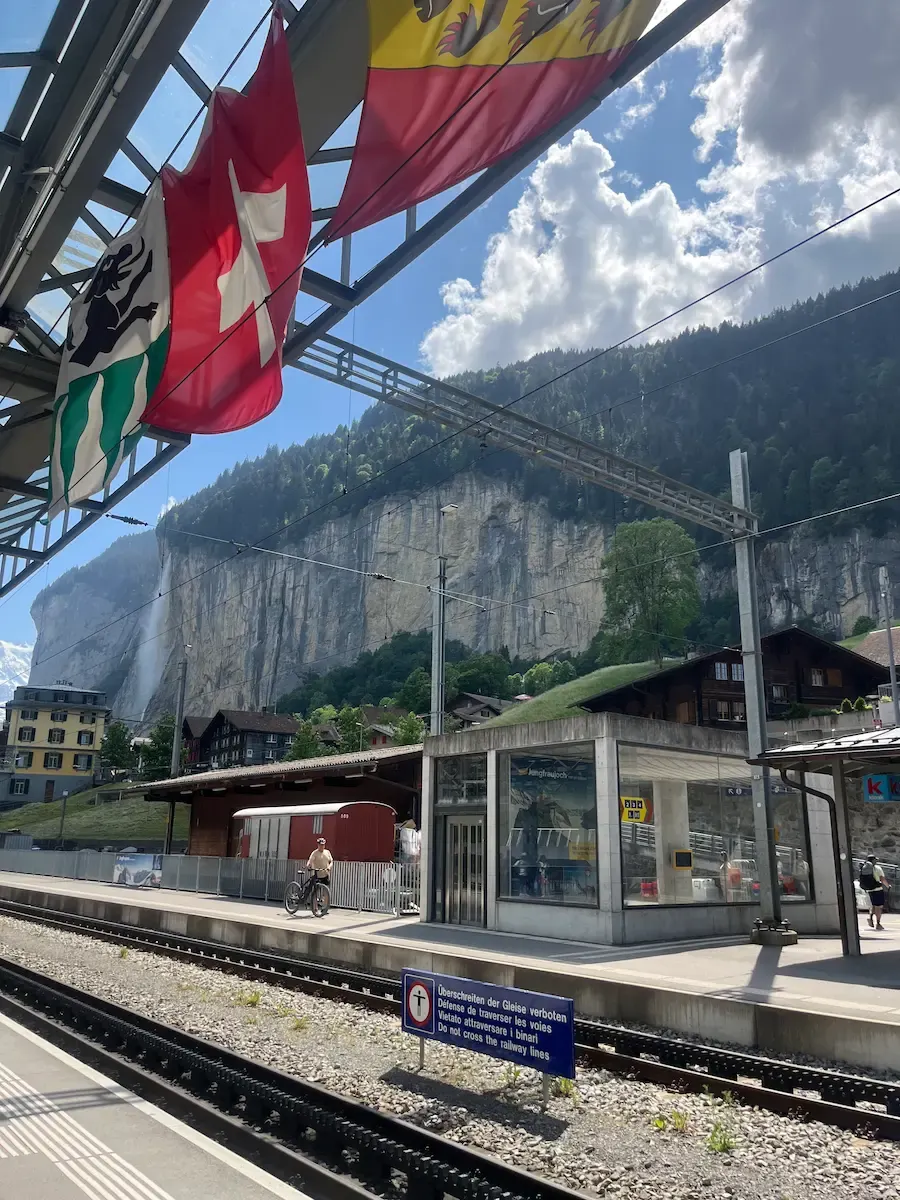
Day 2 in the Jungfrau Region. We'd already done two trains, four cable car rides, a Cliff Walk, and the toboggan run. And then we missed the train towards home. Twin four-year-olds, a six-year-old, two grandparents in their late sixties and seventies and two adults holding everything together by a thread.
It was hot. The twins were done. My dad looked like he needed a nap and my husband looked at me like, is this really your idea of a holiday? We bought snacks from the Coop and waited twenty minutes for the next train. Then we got on the wrong one. I almost had a tantrum myself.
Standing on that platform, the question was hanging in the air. Is this actually the right call — the Jungfrau Region, with grandparents and twin toddlers and all of these logistics?
Yes. But the honest answer is more useful than the short one.
What that day taught us was everything. Build in buffers. Max two transport changes on any big activity day. Know the train number, not just the time. And on the days when the logistics stack up — choose the steamboat over the summit. We swapped our planned Jungfraujoch day for Lake Brienz. It was the right call. The grandparents were visibly relieved. The kids were better for it. And Lake Brienz turned out to be one of the most beautiful things we've done anywhere.
This is the post about how to actually get around the Jungfrau Region with elderly parents and twin toddlers — the passes, the cable cars, the train connections, the Royal Carriage up from Wengen, and the one rule that saved the second half of our trip.
This post contains affiliate links
In This Guide:
- The Honest Picture
- Do You Need a Car?
- BOP vs Jungfrau Pass vs Swiss Half Fare Card
- The Wengen Royal Carriage
- Cable Cars for Elderly Parents and Toddlers
- Swiss Train Connections: What to Know
- Planning Your Days Around the Logistics
- Top Tips
- Practical Information
Do You Need a Car in the Jungfrau Region?
No. And for a family travelling with grandparents and toddlers, that's not a limitation — it's one of the best things about it.
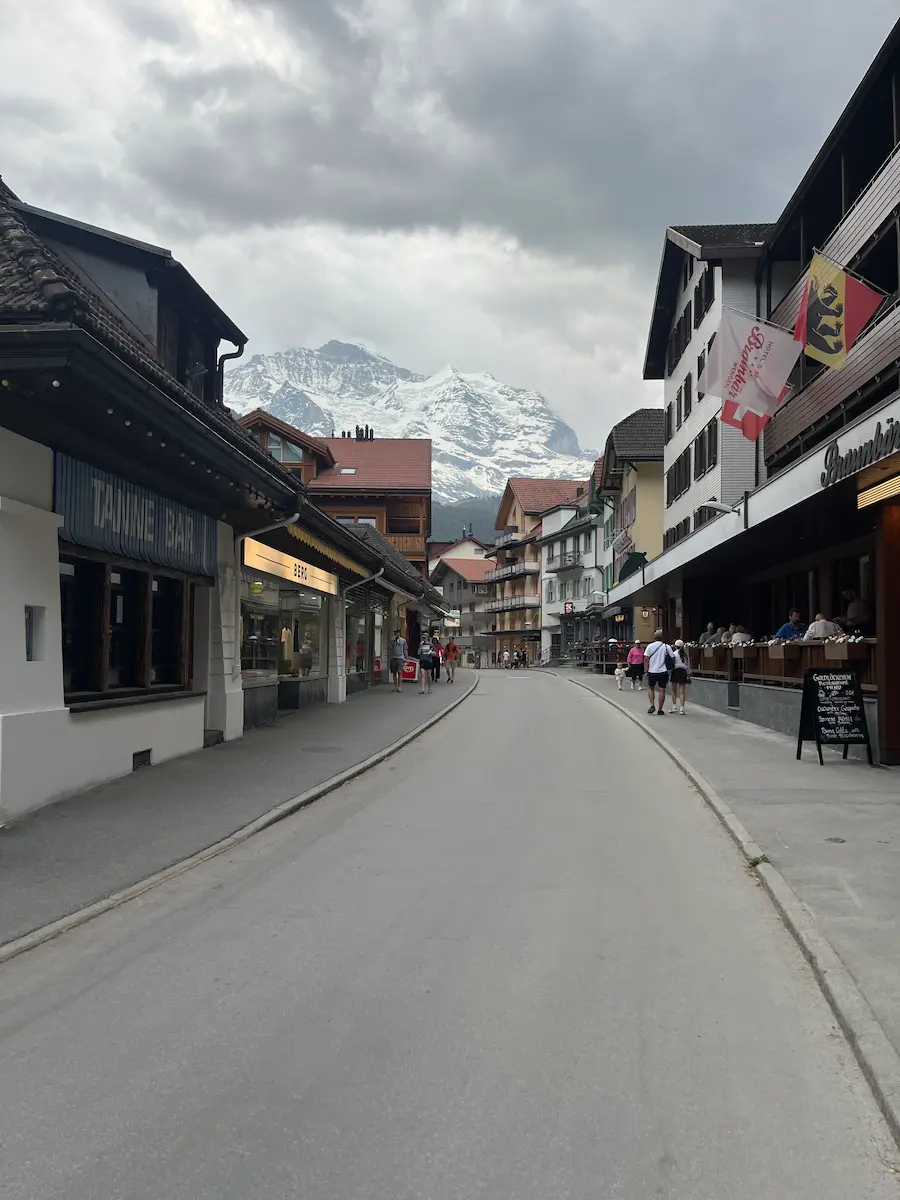
The Jungfrau Region is built around trains, cable cars, and funiculars. Wengen, where we based ourselves, has no roads for private cars at all. You arrive by train, you leave by train, and everything in between moves by rail or on foot. For grandparents who don't want to navigate mountain roads, and toddlers who need to be contained somewhere safe while the adults manage luggage and logistics, that infrastructure is genuinely a gift.
The stroller reality is worth naming. Strollers are manageable on Swiss trains — there's dedicated space and the trains are wide — but short connections on busy days mean you need a plan. Fold or don't fold. Know before you board. On quieter days it was seamless. On Day 2 it was the thing that slowed us down.
The bigger advantage is what car-free Wengen does for the rhythm of the whole trip. No one drives anywhere. Grandparents can walk the village at their own pace in the evening. The kids run ahead on paths with no traffic. It removes an entire category of logistics stress — and for a group of seven spanning four generations, that matters more than it sounds.
The BOP vs Jungfrau Pass vs Swiss Half Fare Card: Which One for Families
This is the question that defeated me for about a week before we left. The Swiss pass system looks simple until you start reading about it, at which point it branches into multiple options and forum threads that contradict each other.
Here is what we actually used, and why.
We bought the 2nd class 6 day Berner Oberland Pass combined with the Swiss Half Fare Card for the adults. They work together — the Half Fare Card gives you 30% discount on the BOP itself and 50% off on all other Swiss transport, and crucially it comes with a free Swiss Family Card for every adult one you buy. The Swiss Family Card allows children aged between 6 and 15 to travel free on Swiss transport when accompanied by a parent. Our six-year-old travelled free because of it. Children under 6 are free on all Swiss transport.
One question that comes up a lot: do pensioners get free travel in Switzerland? The short answer is no — there's no automatic free travel for seniors on Swiss public transport.
The table below shows what each pass covers for the routes we actually used:
| Route / Experience | BOP | Jungfrau Pass |
|---|---|---|
| Trains: Interlaken ↔ Wengen ↔ Grindelwald | ✅ Free | ✅ Free |
| Männlichen cable car from Wengen (Royal Carriage) | ✅ Free + 5 CHF surcharge | ✅ Free + 5 CHF surcharge |
| Pfingstegg cable car (toboggan run) | ✅ Free | 15% off only |
| Grindelwald First gondola (Cliff Walk) | 50% off | 50% off |
| Schilthorn cable cars | ✅ Free | 50% off |
| Allmendhubel funicular | ✅ Free | ✅ Free |
| Lake Brienz steamboat | ✅ Free | ❌ Not covered |
| Jungfraujoch supplement | 25% off | Best discount available |
| Kids aged 6–15 | Free with Swiss Family Card | Free with Swiss Family Card |
The one place the Jungfrau Pass beats the BOP is Jungfraujoch — if that's your main goal, it gives you a better discount on the summit train. For everything else we did, the BOP matched or beat it. And Pfingstegg — the toboggan run the kids still talk about — is free on the BOP and barely discounted on the Jungfrau Pass.
The practical case for this combination is less about the maths and more about the mental load. No buying tickets at machines on a busy platform with three tired children and two grandparents waiting. No calculating whether this cable car is covered or not. You scan, you board, you go. When you're managing seven people across four generations on a hot day at altitude, removing that friction is worth more than the spreadsheet suggests.
One thing I'd do differently: print the passes before you leave home. We had them on our phones and it added unnecessary stress every time we needed to show them — screens timing out, searching through apps, one grandparent holding up a queue. Paper in a pocket is faster.
The Wengen Royal Carriage: What It Is and Why It Works for All Ages
On Day 4 we took the Royal Carriage up from Wengen to Männlichen.
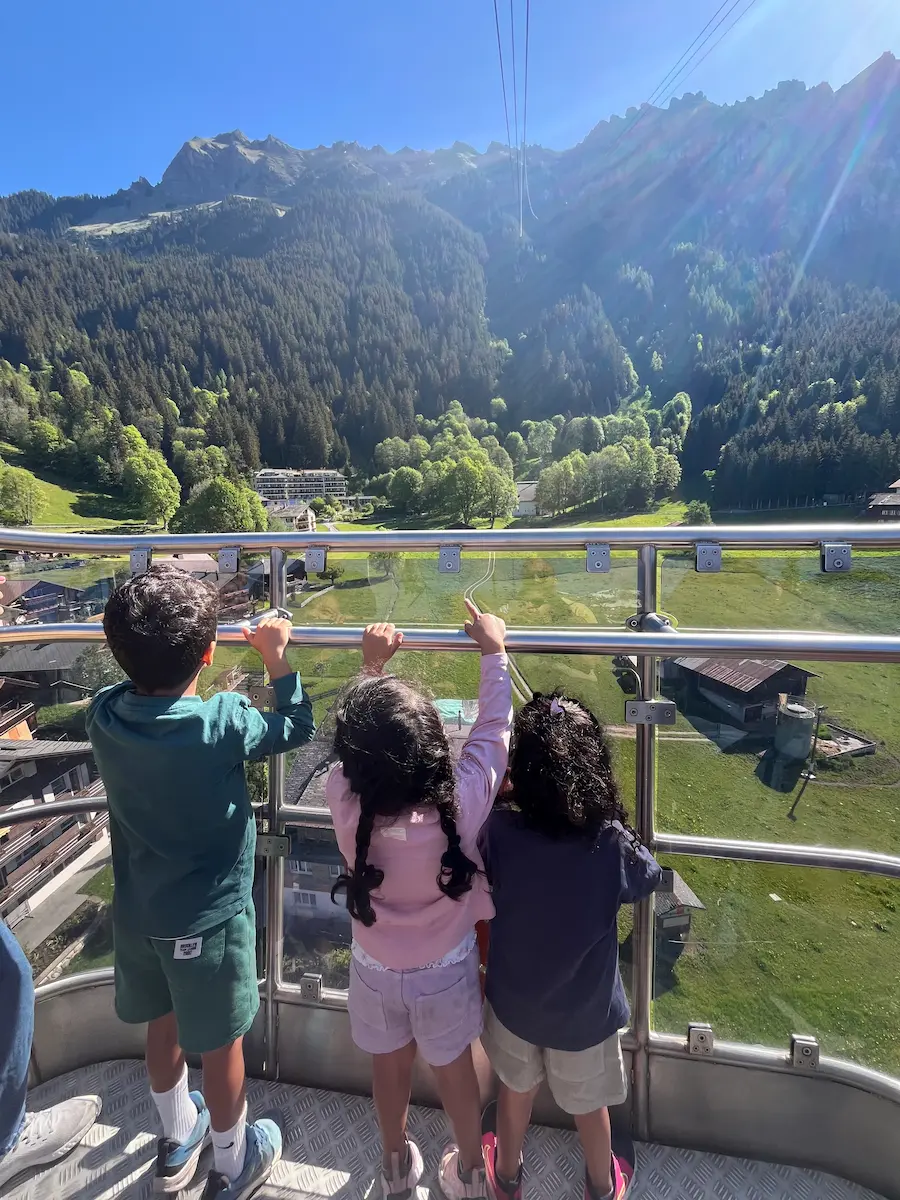
It is an open-top cable car pulled slowly up the mountain, with nothing between you and the Alps but air. Our apartment came into view below us and one of the twins saying look, our house as Wengen disappeared into the valley. The Eiger appeared ahead. It was thrilling to be riding up towards the peak with fresh mountain air hitting your face.
My dad smiled as he took in the 360-degree view from the open carriage, steadily climbing higher and higher. It was his first time riding an open cable car.
There's something special about helping your parents experience firsts as they get older. The beautiful harmony of multi-generational travel — a first for your four-year-old daughter and a first for your seventy-two-year-old father, in the same moment, on the same mountain. That's what it's all about.
It was the same mountain, the same region, the same logistics as the day before. But this was the moment three generations of our family were in exactly the same place, feeling exactly the same thing.
The Royal Carriage is included in the Berner Oberland Pass with a 5 CHF surcharge per person on top of the pass — worth flagging so it doesn't catch you off guard at the station. It departs from Wengen and takes around fifteen minutes to reach Männlichen. It runs in summer only — check the current seasonal schedule before you plan your day around it.
Why it works for this group specifically: it is slow. Unhurried. No rushing off one platform and onto another. Grandparents and toddlers and everyone in between moving at exactly the same pace, going exactly the same place. After the chaos of Day 2 it felt like the region was showing us what it actually is when you stop trying to do too much of it.
Not a compromise. The right call.
If you'd prefer the flexibility of a car — particularly useful if you're planning day trips beyond the Jungfrau Region — rent one in Zurich and base yourself in Lauterbrunnen rather than Wengen. Lauterbrunnen has parking and gives you the same access to the region by train and cable car from there. You can search 7-seater options here — we used the same vehicle for the Rockies and it was worth every penny for a group of seven.
Cable Cars for Elderly Parents and Toddlers: The Great Equaliser
Here is the thing nobody tells you about the Jungfrau Region with a group that spans four generations: the cable cars do the hard work so nobody has to.
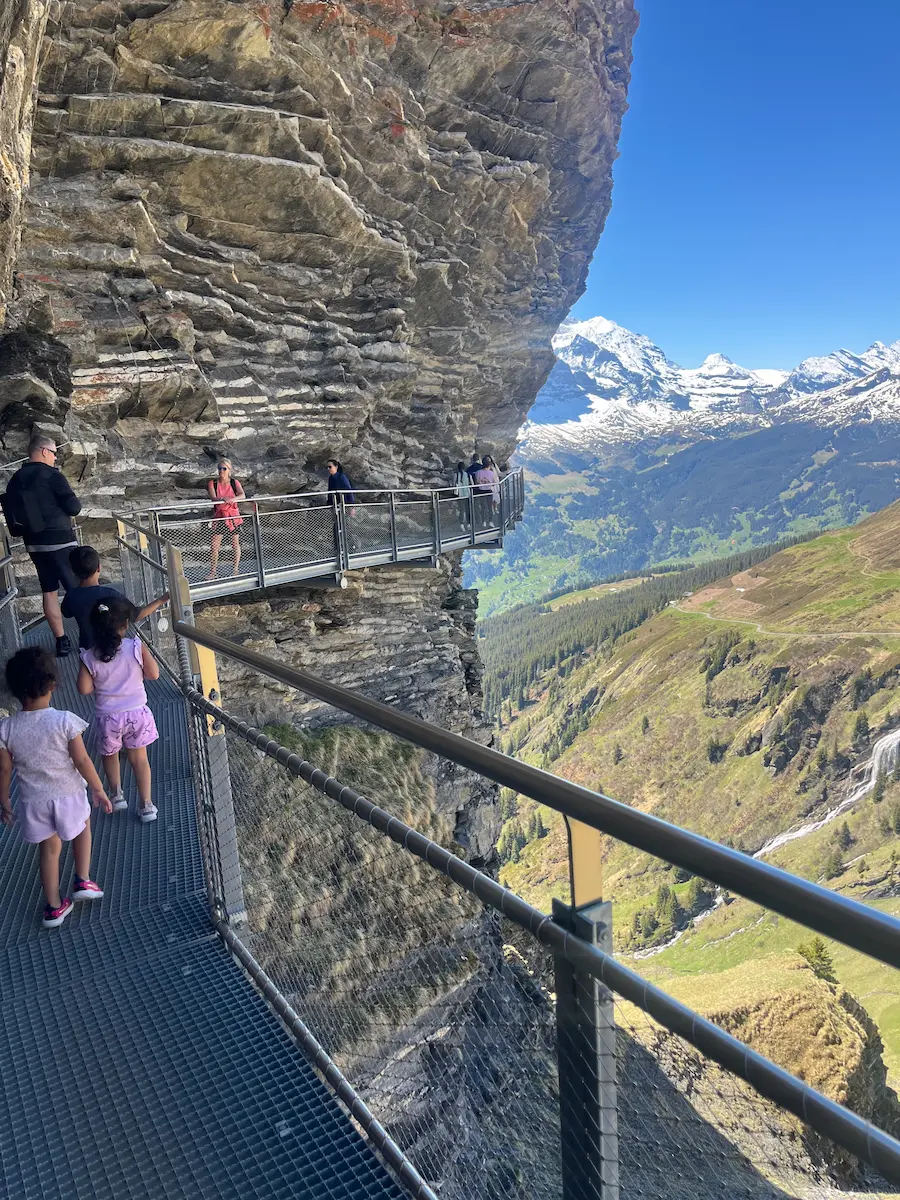
Grandparents in their late sixties and seventies who don't hike reached the same viewpoints as everyone else. Not a reduced version. Not a compromise. The same summit, the same panorama, the same moment — because a cable car did the 2,000 metres of climbing that would otherwise have taken three hours and two knees.
For toddlers it worked differently but equally well. After the first cable car my daughter stopped treating them as an event. By day three she called them flying houses and walked in as though boarding a bus. The twins sat on the floor with their LED writing pads on the longer ascents, completely unbothered by the altitude or the view. It became the norm. That is its own kind of luxury — a four-year-old so comfortable with the logistics that she stops noticing them.
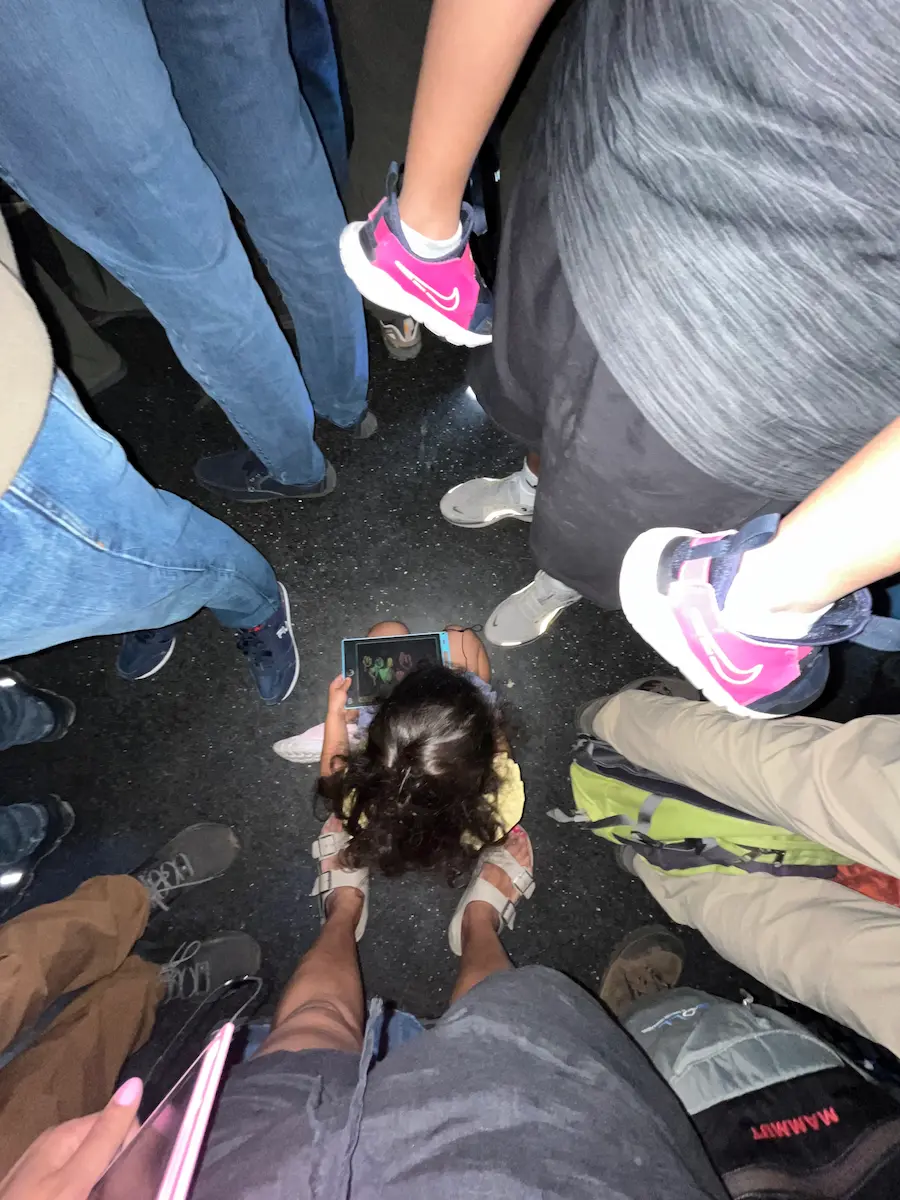
The honest note: cable cars in peak season are busy. Grindelwald First in particular had queues by mid-morning on the days we visited. Getting on the first cable car of the day — or arriving after 3pm — makes a material difference. With elderly parents who find standing in a crowd for twenty minutes draining, this is worth planning around rather than discovering on the day.
Swiss Train Connections: What to Know Before You Go
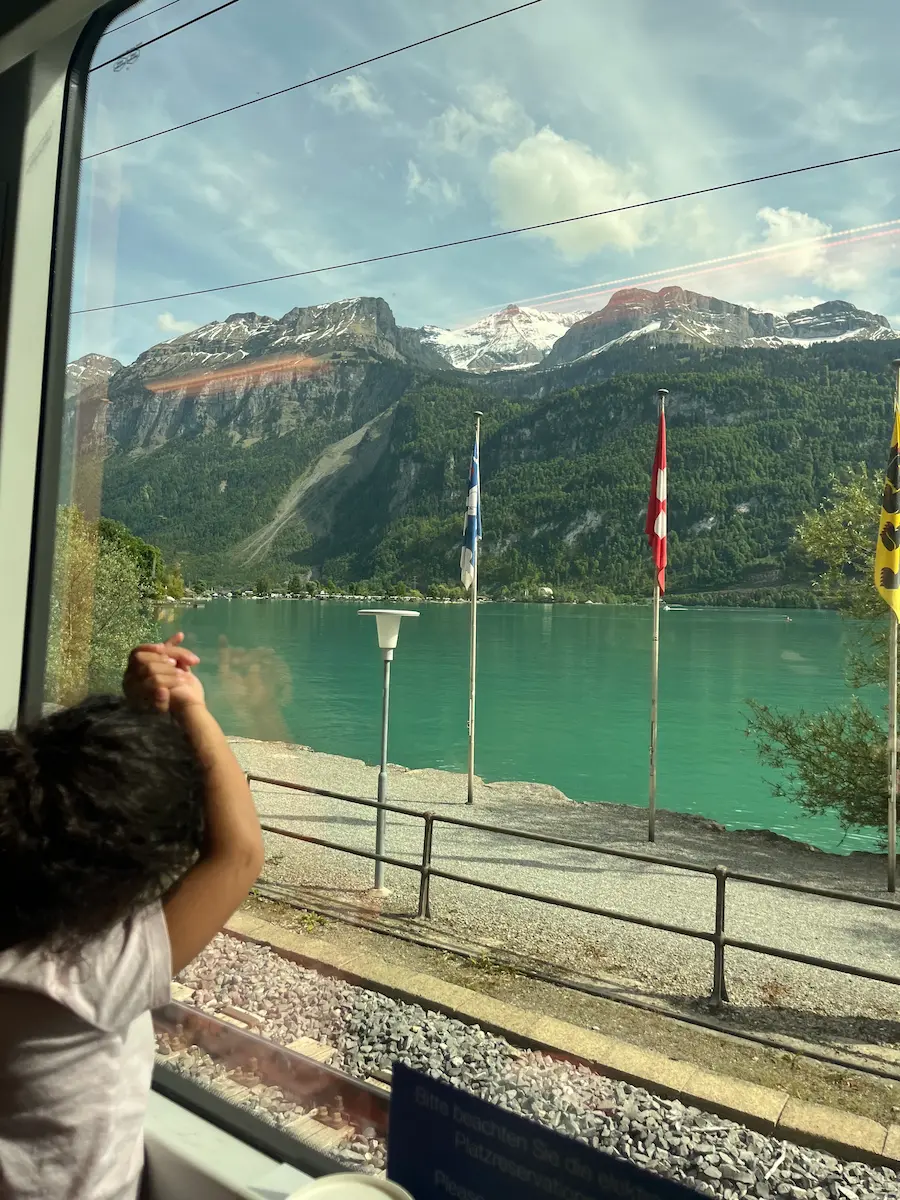
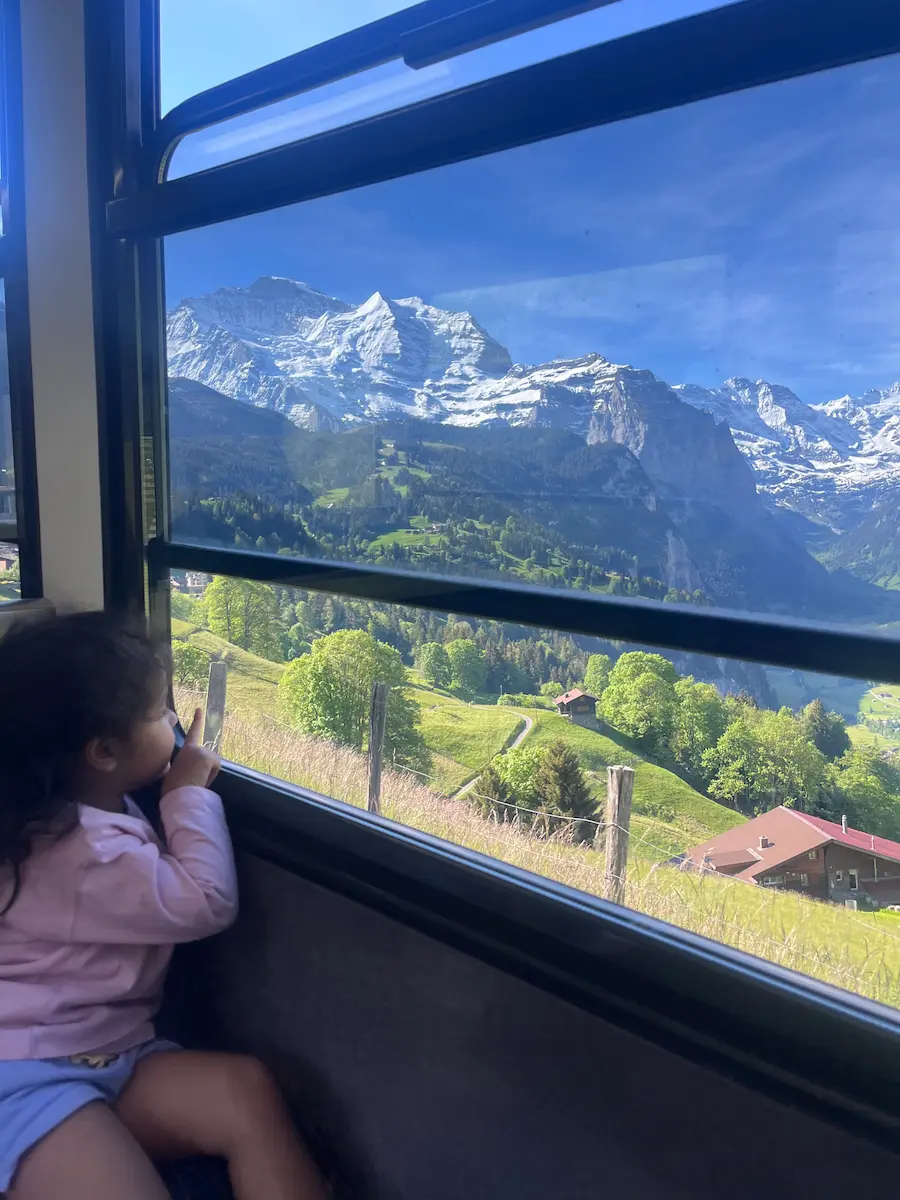
Swiss trains are extraordinary. On time, clean, accessible toilets and scenic beyond what you expect, with views through wide windows that make the journey feel like the destination. The family carriages on longer train rides— marked with a teddy bear symbol in the SBB app — have small play areas that saved us on the longer legs to and from Zurich.
They are also fast. Connections can be as short as four minutes. The train does not wait.
With seven people, a stroller, and grandparents who move at a considered pace, four minutes is tight and an ask. We learned the answer on Day 2, be prepared. Know the time, plarform number and train number, allow yourself time to get there and expect it to be busy.
What worked: PLAN PLAN PLAN. The SBB app shows you exactly which platform, exactly which carriage, exactly which connection — and updates in real time if something changes. Plan your route to and back the night before you so know your how often trains run, tightness of connections and what missing one means for home time. Being on the platform five minutes before the train arrives rather than two minutes after is the difference between a smooth day and an hour's delay with a toddler on the floor of a station eating Coop snacks.
What didn't work: chaining too many connections at the end of a long, hot, full-activity day. On Day 2 we had done Grindelwald First, the Cliff Walk, back down, then Pfingstegg and the toboggan run. By the time we were heading home everyone was done. That is precisely when you make mistakes — wrong platform, wrong train, doors closing in your face. Factor in that your group will be slower and more tired at the end of the day than at the start. Build the buffer in before you need it.
The journey from Zurich on arrival day is worth its own honest mention. Four trains, seven people, all the luggage, two hours after a flight. We took the scenic Lucerne–Interlaken Panoramic Express through the mountains — beautiful, genuinely — but in hindsight the faster direct route would have been the smarter call with this group. Save the scenic train for a day when you're rested and the luggage is already at the apartment.
"The Swiss trains are extraordinary. They are also unforgiving. Know the difference before you arrive."
Planning Your Days in the Jungfrau Region: How Many Transport Legs Is Too Many
The lesson from Day 2 was simple. We'd done it the hardest way possible — four cable car rides, three train legs, the toboggan run, the Cliff Walk, all in one day. In July heat. With twin four-year-olds and two grandparents in their late sixties and seventies.
It was too much. Not because the region is difficult, but because we hadn't built the day around the group we were travelling with.
After that we used one rule: maximum two transport changes on any day with a big activity. If we were going up to Männlichen on the Royal Carriage, that was the transport. Everything else happened from there on foot. If we were doing the steamboat on Lake Brienz, we took the train to Interlaken and that was it. One direction, one mode, one pace.
The Lake Brienz day was the day we'd originally planned differently. We scaled back. A steamboat across the most extraordinarily turquoise water, with the kids at the railings and the grandparents on the deck in the sun, no rushing, no connections to catch, nowhere to be until the boat docked. My dad said it was his favourite day of the trip.
Not the summit. The steamboat.
That is the rhythm that works for this group: one demanding day, one slower day. Let the region breathe. The cable cars will still be there tomorrow.
Top Tips for Getting Around the Jungfrau Region with Grandparents and Toddlers
- Print your passes. Having the BOP and Half Fare Card on your phone adds stress at busy platforms. Paper in a pocket is faster for everyone, including grandparents unfamiliar with the app.
- Know the train number, not just the time. The SBB app shows you the exact train number, platform, and real-time updates. Search your next connection before you board the current one.
- Maximum two transport changes on big activity days. Chain too many legs together and someone — a grandparent, a toddler, or yourself — will hit a wall before you get home.
- Build 20-minute buffers at the end of long days. Not because Swiss trains are unreliable. Because your group will be slower and more tired than they were this morning.
- Get on the platform early. Two minutes before the train arrives, not two minutes after it leaves.
- Take the faster arrival route from Zurich. The Panoramic Express is beautiful. It is also long. With seven people, all the luggage, and two hours post-flight, the faster direct train to Interlaken is the smarter first-day call. Save the scenic rail for when you're rested.
- Use the family carriage. Look for the teddy bear symbol in the SBB app when searching your route. Small play area, more space, less stressed toddlers on longer legs.
- Let the cable cars do the climbing. Plan your days around cable car access first, hiking second. This is what makes the Jungfrau Region work for elderly parents and toddlers simultaneously.
- One slower day for every busy one. The steamboat on Lake Brienz. A village morning in Wengen. Something without a connection to catch. It makes the active days better for everyone.
- The Royal Carriage is worth the 5 CHF surcharge. Build it into your itinerary, not as an afterthought.
Practical Information
Getting the passes
- Berner Oberland Pass — available for 3, 4, 6, 8, or 10 consecutive days. Buy with a Half Fare Card (below) for a reduced price.
- Swiss Half Fare Card — one month, 50% off almost all Swiss transport. Comes with a free Swiss Family Card.
- Swiss Family Card — free with the Half Fare Card. Children aged 6–15 travel free on Swiss transport when accompanied by a parent. Select it when buying your half fare card for free.
- Children under 6 travel free on Swiss trains when accompanied by an adult with a valid pass. No additional card needed.
Getting around
- SBB app — download before you leave home. Live train times, platform numbers, connection search, teddy bear symbol for family carriages.
- Wengen is car-free. You arrive and leave by train from Lauterbrunnen. No driving, no parking, no mountain roads.
- Double strollers are manageable on Swiss trains but plan for short connections. Know your fold/no-fold decision before you board.
Royal Carriage
- Departs from Wengen station to Männlichen.
- Included in the BOP with a 5 CHF surcharge per person.
- Runs summer only — check the current seasonal schedule at jungfrau.ch before planning your day around it.
Getting there from Zurich
- Direct train Zurich to Interlaken Ost, then change for Lauterbrunnen and Wengen.
- Journey time approximately 2.5 hours on the faster route.
- The Lucerne–Interlaken Panoramic Express is scenic and covered by the BOP but adds time. Save it for a day when you're not arriving with all your luggage.
Where we stayed
We based ourselves in Wengen in the Hotel Brunner apartment — three bedrooms, a balcony facing the Eiger, and a kitchen that meant we weren't eating out for every meal with five children. For the full accommodation guide, read Why We Chose Wengen Over Grindelwald.
More from the Switzerland:
- 7-Day Jungfrau Region Itinerary with Grandparents and Toddlers
- Why We Skipped Jungfraujoch — and What We Did Instead
- Where to Stay in the Jungfrau Region: Why We Chose Wengen
If the idea of train connections feels like too much for your group, our Canadian Rockies guide might be the better starting point — a multi-generational road trip where you set the pace entirely.
We travelled to the Jungfrau Region in May 2026 with twin four-year-olds, a six-year-old, and two grandparents in their late sixties and seventies. All recommendations are based on our own experience. This post contains affiliate links — if you book through our links we may earn a small commission at no extra cost to you.